Metallized Paper vs. Foil Label vs. BOPP: The Complete Beer Label Substrate Comparison Guide for 2026

Published: June 2026 | 14 min read | Audience: Packaging Procurement Managers & Brand Packaging Development Engineers
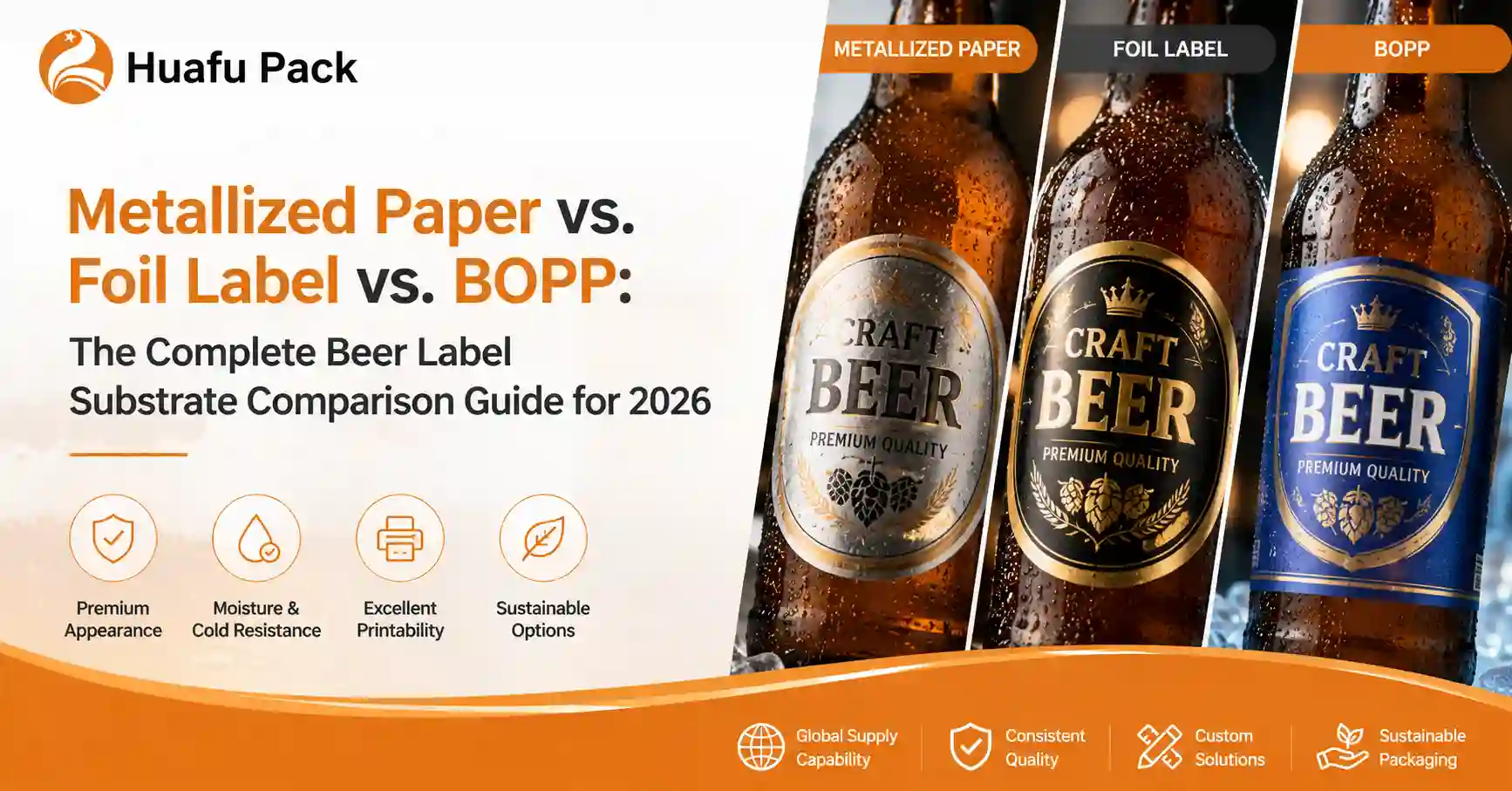
The specification sheet has been sitting in your inbox for three days. Your packaging development engineer wants vacuum metallized paper. The brand team is asking why you can't just use the foil label that the premium lager next to you on the shelf is using. Your sustainability director has forwarded a PPWR compliance memo for the fourth time this month and is asking about BOPP. The supplier you've been using for two years just quoted a 12% price increase on their current stock.
Welcome to the beer label substrate selection decision in 2026. Three competing materials. Four internal stakeholders pulling in different directions. One purchase order that will lock your production line into a specific substrate for the next 12 to 18 months minimum.
Most substrate comparison guides you find online are written by suppliers who manufacture one of the three materials and have a commercial interest in the outcome. This one is written from the position of a manufacturer who makes both vacuum metallized paper and holographic metallized variants — but who also understands that the wrong substrate choice for a specific application creates quality problems and returns that nobody wants. The most useful thing I can give you is an honest, data-supported framework for making this decision, not a sales pitch for a single material.
So here is the complete, unvarnished comparison of the three dominant beer label substrates in use in 2026: vacuum metallized paper, aluminum foil labels, and BOPP metallized film. Scored across the four dimensions that actually determine whether a procurement manager can defend the decision to every internal stakeholder simultaneously.
📑 Material Selection Guide — Contents
Dimension 1 — Total Cost of Ownership: Unit Price Is Only the Starting Point
Dimension 2 — Wet Performance: The Ice Bucket, the Pasteurizer, and the Bottle Washer
Dimension 3 — Printability & Converting: Press Room Reality vs. Supplier Claims
Dimension 4 — Sustainability & Regulatory Compliance: PPWR, EPR, and Beyond
The Master Scorecard: All Three Substrates Across All Four Dimensions
1. The Three Materials: What They Actually Are
Before scoring, every procurement manager needs a clear material definition. Confusing these three substrates at the specification stage — which happens more often than suppliers admit — leads to incorrect sampling, wrong press parameters, and avoidable quality failures.
Material A: Vacuum Metallized Paper
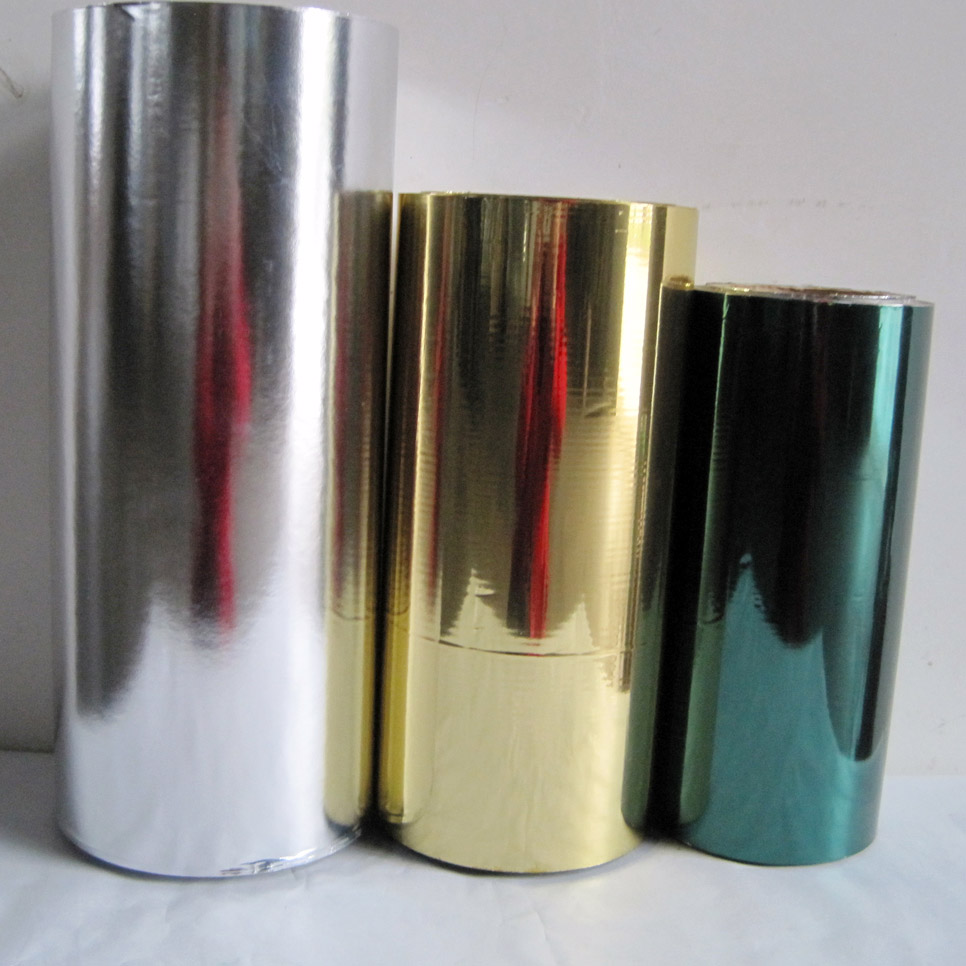
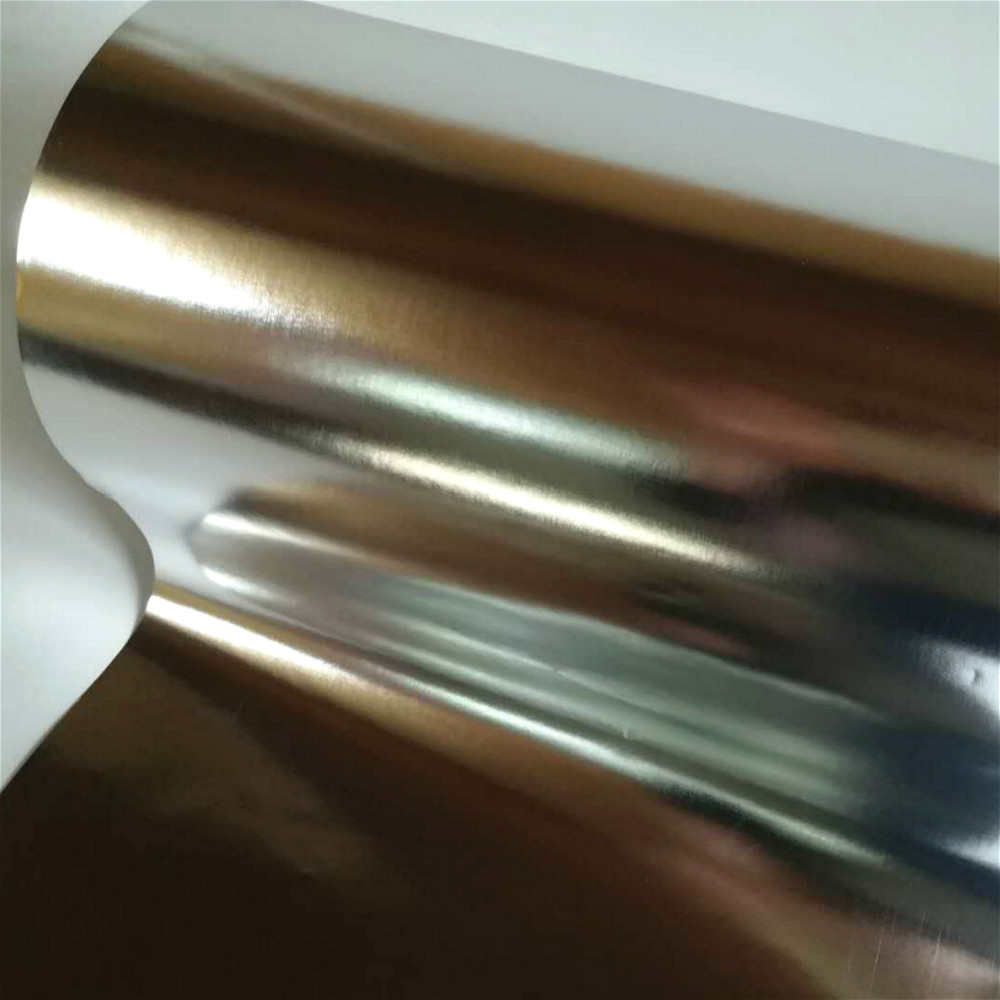
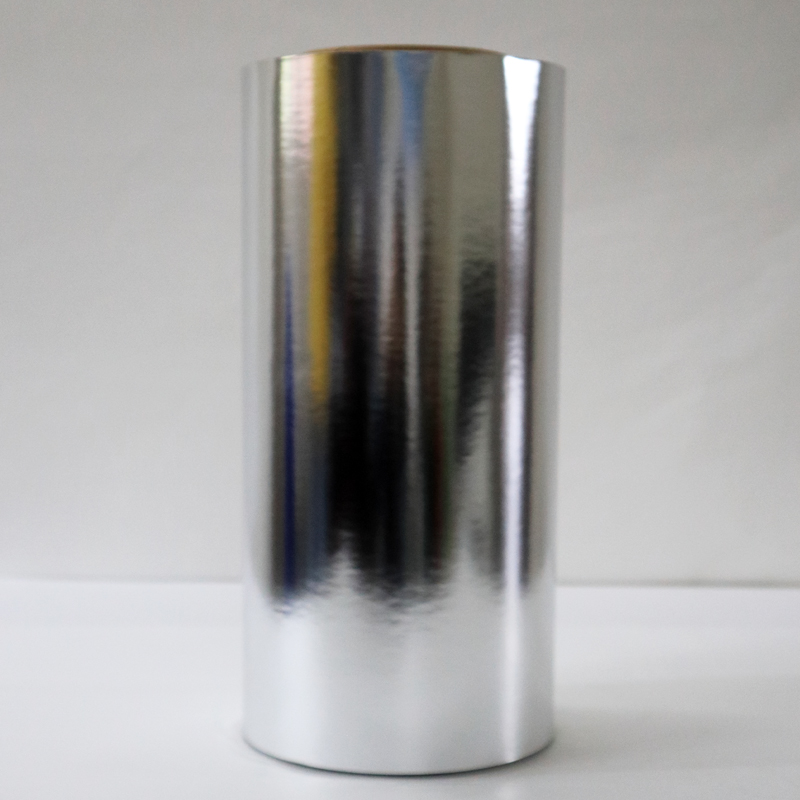
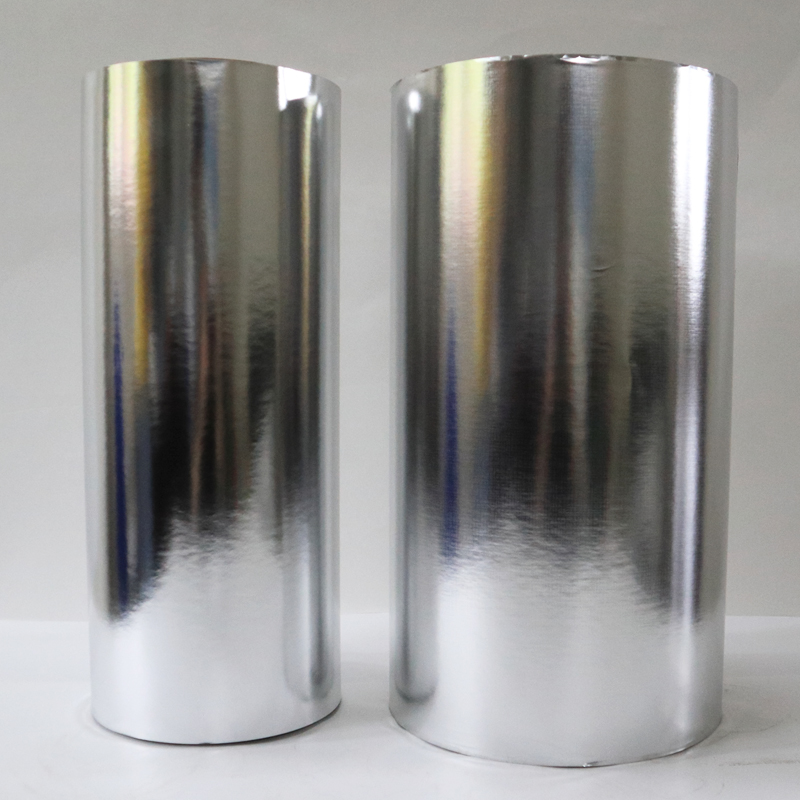
A base paper (typically 60–120 gsm, depending on application) that has had a pure aluminum layer vapor-deposited onto its surface inside a vacuum chamber. The aluminum coating is 25–40 nanometers thick — far thinner than a single wavelength of visible light. A specialist top coating is applied over the aluminum layer to provide a printable, protected surface. The dominant material by weight and by fiber content is cellulose paper. Aluminum content by weight is negligible — typically under 0.3% of total roll weight.
This is the category of product manufactured at Huafu Pack's Xianning facility, with an annual production capacity of 5,000 tons. It includes standard silver metallized paper, gold metallized paper, and holographic embossed variants. The structural baseline is always the same: paper substrate, vacuum-deposited aluminum layer, functional top coating.
Material B: Aluminum Foil Label
A composite construction in which a solid aluminum foil sheet — typically 6 to 12 microns thick, or 6,000–12,000 nanometers — is laminated to a paper or film carrier substrate using an adhesive layer. The resulting composite is rigid, dimensionally stable, and carries a true solid metallic layer rather than a deposited coating. Total aluminum content by weight is many hundreds of times greater than in vacuum metallized paper. The composite construction makes it a multi-material laminate for recycling purposes.
Material C: BOPP Metallized Film
Biaxially Oriented Polypropylene (BOPP) film — a plastic substrate manufactured by stretching polypropylene in two directions to improve tensile strength and clarity — with a vacuum-deposited aluminum layer applied to one surface. The base substrate is plastic, not paper. The aluminum coating thickness is comparable to that of metallized paper (approximately 30–50 nm). The dominant material by weight and by material category is polypropylene plastic. This is the substrate whose sustainability position is most directly challenged by EU Regulation 2025/40 (PPWR).
2. Dimension 1 — Total Cost of Ownership: Unit Price Is Only the Starting Point
The procurement manager's instinct is to start with price per ton or price per thousand square meters. That is a reasonable starting point. It is a very poor finishing point. The true cost of a label substrate procurement decision includes five cost components, and comparing only the unit price of Material A against Material B while ignoring the other four produces a decision that looks efficient on a spreadsheet and causes cost overruns in production.
Cost Component 1: Raw Material Unit Price
In 2026 market conditions, the approximate relative pricing position of the three substrates, expressed as an index where vacuum metallized paper = 100:
| Substrate | Relative Unit Price Index | Primary Cost Driver |
|---|---|---|
| Vacuum Metallized Paper | 100 (baseline) | Base paper + vacuum deposition process + top coating |
| BOPP Metallized Film | 110 – 130 | BOPP film base + polypropylene resin price volatility + biaxial orientation process |
| Aluminum Foil Laminate | 180 – 250 | Solid aluminum foil raw material (LME aluminum price-linked) + lamination process cost |
Cost Component 2: Press Waste and Spoilage Rate
Vacuum metallized paper runs on standard flexo and offset label presses without equipment modification. BOPP film requires web tension recalibration and occasionally web guide adjustment — most converters absorb this as a 2–5% press setup premium on the first job with a new roll specification. Aluminum foil laminate, being the most dimensionally rigid of the three, creates the highest risk of die-cutting waste at tight registration tolerances. In a high-volume production environment, a 3% difference in spoilage rate across a 10-million-label annual program is a meaningful cost line.
Cost Component 3: EPR Fee Differential (EU Markets)
Under the PPWR framework operational from August 2026, EPR fee modulation across EU Member States directly ties packaging material choices to recurring compliance costs. BOPP metallized film faces a structurally higher EPR fee rate than paper-based metallized substrates in Germany (LUCID), France (CITEO), and the Netherlands — because the fee modulation algorithm penalizes plastic-on-glass packaging combinations. This is not a projected cost. It is a line item in your 2026 and 2027 compliance budget. For brands shipping 5 million or more labeled units per year into the EU, the EPR fee differential between BOPP and paper-based substrates represents a measurable annual cost gap.
Cost Component 4: Sample and Qualification Cost
Free A4 substrate samples for initial evaluation are standard practice for vacuum metallized paper suppliers including Huafu Pack. For aluminum foil laminate, sample costs are typically passed through due to the higher raw material cost. Factor qualification run waste (typically 2-ton trial minimum) into your total cost of ownership calculation when comparing substrate switching costs.
📖 Full PPWR and EPR fee modulation analysis for beer label substrates: Sustainable Beer Label Paper in 2026: How to Stay PPWR-Compliant Without Losing Your Metallic Shelf Impact
3. Dimension 2 — Wet Performance: The Ice Bucket, the Pasteurizer, and the Bottle Washer
Beer labels face three distinct and contradictory wet stress environments across their operational life. A substrate that passes one test and fails another is commercially unacceptable. Understanding how each material performs across all three stress conditions — and what determines the performance outcome — is essential for packaging engineers specifying substrate for any brewery that operates across more than one route to market.
Stress Environment 1: Ice Bucket Cold Water Immersion (2–4°C, 2–72 hours)
The consumer-facing test. Craft beer sold into premium bottle shop and restaurant channels will spend meaningful time in ice buckets. The label must maintain visual integrity — no wrinkling, blistering, delamination, or ink dropout — for the duration of a typical serving occasion.
Vacuum Metallized Paper: Performance is substrate-specification-dependent. Base paper without wet-strength resin treatment will fail this test within 1–2 hours. Base paper with appropriate wet-strength resin cross-linking (confirmed by Cobb60 ≤25 g/m²) performs excellently for 72+ hours. This is a specifiable, controllable parameter — request the Cobb value in the COA for every batch.
BOPP Metallized Film: Inherently moisture-resistant due to the plastic base substrate. The aluminum layer does not absorb water and the polypropylene film base is dimensionally stable in cold water. Strong performance in this specific test — which is why BOPP became the default choice for premium beer labels in markets where sustainability was not a selection criterion.
Aluminum Foil Laminate: The solid foil layer provides a complete moisture barrier. Cold water performance is excellent. The laminate construction is inherently water-resistant at the face material level.
Stress Environment 2: Tunnel Pasteurization (60–65°C hot water spray, 20–30 minutes)
Commercial breweries running tunnel pasteurizers subject filled, sealed, labeled bottles to sustained hot water spray at 60–65°C for 20–30 minutes. This is the opposite of the ice bucket — sustained wet heat rather than cold immersion — and it creates a completely different failure mode. The hot water softens adhesive bonds, drives moisture into paper fiber structures, and thermally stresses polymer top coatings.
Vacuum Metallized Paper: Requires specific wet-strength and heat-resistance specification. The top coating formulation must be selected for thermal stability at the pasteurization temperature range. Standard commercial metallized paper passes a correctly specified pasteurization trial. The Cobb value requirement for pasteurization resistance is more demanding than for ice bucket resistance — target Cobb60 ≤20 g/m² for breweries running tunnel pasteurizers.
BOPP Metallized Film: The polypropylene film base can exhibit dimensional changes at sustained temperatures above 60°C — BOPP has a relatively low heat deflection threshold for a film substrate. For breweries running pasteurizers at the upper end of the 60–65°C range, BOPP label wrinkle during pasteurization is a documented production quality issue that requires careful adhesive and substrate specification to manage.
Aluminum Foil Laminate: The solid foil layer provides thermal stability that paper and film cannot match. For tunnel pasteurization applications, aluminum foil laminate is the most technically robust choice, which partly explains its premium market position in the commercial brewing sector.
Stress Environment 3: Hot Caustic Bottle Washing (80°C, 1.5–2.5% NaOH, 15–30 minutes)
Returnable glass bottle programs — standard in Germany, Austria, and growing in Scandinavia under deposit scheme legislation — require labels to detach cleanly from bottles in an industrial caustic wash cycle. The label must come off in one intact piece. It must not disintegrate into pulp that clogs the washing filters. And the glass surface must emerge adhesive-residue-free and ready for relabeling.
Vacuum Metallized Paper: When correctly specified with wash-off adhesive and appropriate base paper, metallized paper performs well in caustic bottle washing. The paper's cellulose fiber structure, while initially moisture-resistant from wet-strength treatment, is designed to allow rapid penetration by hot alkaline solution — the label curls away from the glass in a coherent sheet. This is the "wash-off" characteristic that glass recyclers and returnable bottle operators specifically require.
BOPP Metallized Film: The plastic substrate creates a significant wash-off problem. BOPP does not disintegrate or dissolve in hot caustic solution — it detaches as a plastic film fragment that must be filtered from the washing solution. In high-volume bottle washing operations, BOPP film fragments accumulate in filters and create maintenance overhead. Several large European brewery groups have switched away from BOPP labels specifically to reduce bottle washing complications.
Aluminum Foil Laminate: Depends entirely on the laminate construction. Foil-paper laminates can be designed for wash-off performance. Foil-film laminates carry the same caustic wash complications as BOPP film. Specifying "foil label" without clarifying the carrier construction is insufficient for returnable bottle applications.
4. Dimension 3 — Printability & Converting: Press Room Reality vs. Supplier Claims
Every substrate supplier will tell you their material is "fully compatible with standard label presses." This statement is technically true and practically misleading. All three substrates can be printed on standard UV flexo or offset presses. The meaningful differences are in setup complexity, process sensitivity, equipment modification requirements, and the range of print effects achievable. These differences determine your converter's willingness to run the job, the press time premium you pay, and the realistic quality ceiling for your label artwork.
Vacuum Metallized Paper — Printability Profile
Surface tension requirement: ≥38 dyne/cm (measured per ISO 8296 at point of use). Confirmed by corona treatment during manufacture and verified at receiving inspection. Degrades over time through hydrophobic recovery — storage conditions and roll age matter.
Press setup adjustment from standard paper: Minimal. Tension settings, anilox volumes, and UV cure parameters require minor calibration on first job but do not differ significantly from standard coated paper stocks.
Ink adhesion mechanism: Surface energy dependent. No mechanical fiber penetration. Tape test qualification per ASTM D3359 and wet adhesion test per FINAT protocols required for every new substrate batch approval.
Special effects capability: Holographic embossing available as standard variant. Transparent ink printing over metallic surface produces distinctive color-tinted metallic effects not achievable on film substrates.
Die-cutting performance: Cuts cleanly. Caliper tolerance tighter than film substrates — request ±2 gsm caliper tolerance from supplier for high-speed rotary die-cutting applications.
BOPP Metallized Film — Printability Profile
Surface tension requirement: ≥38 dyne/cm equally required. BOPP surfaces also undergo hydrophobic recovery but the recovery rate can differ from paper-based top coatings.
Press setup adjustment from standard paper: Moderate. Web tension must be recalibrated — BOPP film has significantly different tensile modulus from paper. Reduce unwind tension by 15–20% from paper settings as a starting point. Moisture management less critical than paper (BOPP is non-hygroscopic).
Die-cutting performance: Film substrates can smear at die-cut edges if blade geometry is not optimised for plastic film cutting. Tool clearance settings differ from paper. Converter experience with film substrates is a prerequisite for acceptable die-cut quality.
Dimensional stability: Superior to paper in humidity-variable press rooms. This is a genuine practical advantage for converters in tropical or humid-season climates.
Special effects capability: Holographic BOPP film variants available. The plastic base can carry a wider range of surface effect embossings due to the film's higher tensile strength.
Aluminum Foil Laminate — Printability Profile
Press setup adjustment from standard paper: Significant. The foil laminate's rigidity creates higher web tension requirements and reduces the press speed ceiling on narrower presses. Many label converters apply a press time premium of 15–25% for foil laminate jobs.
Register precision: The foil layer's rigidity can work in its favor for multi-color register accuracy on well-maintained presses — less stretch-related misregister than paper. However, any wrinkle or tension variation in the foil layer creates defects that are impossible to correct in press and immediately visible on the finished label.
Embossing and hot foil stamping compatibility: The foil base is the most compatible of the three substrates for additional embossing and hot foil stamp finishing processes — providing the deepest, most defined tactile relief effect.
Converter surcharge reality: Be direct with your label converter and ask for their foil laminate press surcharge upfront. It varies by press width and setup complexity but is rarely zero. Factor it into your true converting cost per thousand labels.
📖 Deep technical guide on printability parameters for metallized paper specifically: Metallized Paper Printability: The Press Technician's Complete Guide to Ink Adhesion, Corona Treatment & Surface Tension
5. Dimension 4 — Sustainability & Regulatory Compliance: PPWR, EPR, and Beyond
In 2022, sustainability was a brand values discussion. In 2024, it was a CSR reporting metric. In 2026, it is a procurement cost driver and a market access risk. The PPWR's formal implementation means that substrate recyclability is no longer a soft criterion in a material selection scorecard — it is a hard compliance variable with financial and legal consequences.
Recyclability Profile Summary
The recyclability assessment under the PPWR framework evaluates packaging based on its compatibility with existing collection and sorting infrastructure, the technical recyclability of the material once sorted, and its impact on the recycling process for other materials in the same stream. For beer label substrates applied to glass bottles:
Vacuum Metallized Paper: Paper-dominant fiber structure. Compatible with paper recycling streams at the end-of-bottle-life stage for non-returnable bottles. Compatible with glass recycling programs when specified with wash-off adhesive for returnable bottles. The nano-thin aluminum layer presents minimal contamination to paper fiber recovery processes. Targeting PPWR recyclability Grade B or C — within market-access safe thresholds post-2030.
BOPP Metallized Film: Plastic substrate. Incompatible with paper recycling streams. Creates contamination in glass recycling streams when labels do not detach cleanly in caustic washing. The polypropylene film base, while technically recyclable as a plastic, is not collected or sorted as a label stream in any major EU Member State's household collection infrastructure. Likely PPWR recyclability Grade D or E — at market-access risk post-2030 in current form.
Aluminum Foil Laminate: Multi-material composite. Recyclability profile depends on laminate construction. Foil-paper laminates are more favorably assessed than foil-film laminates. The high aluminum content by weight means the material has intrinsic recycled material value — but the composite structure creates sorting and separation challenges that reduce the effective recyclability grade. Estimated Grade C to D depending on construction specifics and Member State infrastructure.
6. The Master Scorecard: All Three Substrates Across All Four Dimensions
The following scorecard assigns a performance rating across the four evaluation dimensions for each of the three substrates. Ratings use a simple five-point scale: ★★★★★ (Excellent) through ★☆☆☆☆ (Poor). The rating reflects typical commercial performance under standard beer label application conditions — not best-case laboratory results or worst-case production failures.
| Evaluation Dimension | Vacuum Metallized Paper | BOPP Metallized Film | Aluminum Foil Laminate |
|---|---|---|---|
| Unit Material Cost | ★★★★★ | ★★★☆☆ | ★★☆☆☆ |
| EPR / Compliance Cost (EU) | ★★★★★ | ★★☆☆☆ | ★★★☆☆ |
| Ice Bucket Wet Resistance | ★★★★☆ (spec-dependent) | ★★★★★ | ★★★★★ |
| Pasteurization Resistance | ★★★★☆ (spec-dependent) | ★★★☆☆ | ★★★★★ |
| Caustic Wash-Off Performance | ★★★★★ | ★★☆☆☆ | ★★★☆☆ (construction-dependent) |
| Press Convertibility | ★★★★★ | ★★★★☆ | ★★★☆☆ |
| Visual Metallic Effect | ★★★★★ | ★★★★★ | ★★★★★ |
| EU PPWR Recyclability Grade | ★★★★☆ (targeting B–C) | ★★☆☆☆ (risk: D–E) | ★★★☆☆ (C–D estimated) |
| Supply Chain Flexibility (MOQ/Lead Time) | ★★★★★ (2 ton MOQ, 15-day OEM) | ★★★★☆ | ★★★☆☆ |
Aggregate Score (out of 45 stars maximum):
🥇 Vacuum Metallized Paper: 41 / 45 — Highest overall score. Leads on cost, compliance, convertibility, wash-off performance, and supply chain flexibility. Wet performance requires correct specification but is fully achievable.
🥈 Aluminum Foil Laminate: 33 / 45 — Strongest on absolute wet performance (ice bucket + pasteurization). Justified premium for tunnel pasteurization-intensive commercial brewing. Loses points on cost, convertibility, and recyclability.
🥉 BOPP Metallized Film: 31 / 45 — Strong on cold wet performance and dimensional stability. Significantly penalised on EU compliance and wash-off performance. Total cost of ownership is being recalculated unfavorably across EU markets as EPR modulation activates.
7. Decision Framework: Which Substrate for Which Application
The master scorecard gives you the aggregate picture. Here is the application-specific guidance — because a substrate that is the right choice for a craft brewery selling into UK bottle shops may be the wrong choice for a large commercial brewer running tunnel pasteurization in Germany with a returnable bottle program.
| Application Profile | Recommended Primary Substrate | Key Rationale |
|---|---|---|
| Craft / premium beer, non-returnable bottle, EU + UK market, ice bucket environment | ✅ Vacuum Metallized Paper (wet-strength specified) | Best cost, best compliance profile, full shelf and ice bucket performance when Cobb60 ≤25 g/m² specified. |
| Large commercial brewery, tunnel pasteurization, high-volume output, non-EU market | ⚠️ Aluminum Foil Laminate or Wet-Strength Metallized Paper (with pasteurization trial) | Foil laminate provides the highest pasteurization robustness. Metallized paper with enhanced specification can pass pasteurization trials — requires formal qualification run. |
| Returnable glass bottle program, EU market, caustic wash cycle | ✅ Vacuum Metallized Paper (wash-off adhesive specified) | Superior caustic wash-off performance. BOPP film creates filter contamination in bottle washers. Paper exits washer as coherent sheet. |
| Ultra-premium limited edition, US / APAC market, maximum shelf impact, no sustainability mandate | ⚠️ Aluminum Foil Laminate or Holographic Metallized Paper | Where price premium is acceptable and sustainability compliance is not a near-term constraint, foil laminate's tactile premium feel justifies the cost. Holographic metallized paper achieves visual equivalence at lower cost. |
| Any application, EU market, post-2028 new product specification | ✅ Vacuum Metallized Paper (default) | PPWR recyclability grading hard ban on Grade D/E from 2030. BOPP film is at market-access risk. Paper-based substrate is the future-proof default for EU label programs. |
8. FAQ: Procurement Manager Questions, Answered Directly
A: If your application is outside the EU and you have no returnable bottle program, there is no immediate quality argument for switching — BOPP metallized film performs well in cold water environments and prints reliably. The argument for switching is forward-looking and financial: EPR fee modulation in EU markets is creating a progressive cost disadvantage for BOPP labels, and the PPWR market-access restriction on Grade D/E packaging from 2030 represents a potential regulatory constraint on EU distribution. If even a portion of your volume sells into the EU, initiating a substrate qualification program now — while it is an optimization project rather than an emergency switch — is the lower-risk path. The qualification process for metallized paper is straightforward and the starting point is a free A4 sample.
A: No. Vacuum metallized paper with enhanced wet-strength specification (Cobb60 ≤20 g/m²) and a thermally-stable top coating formulation can pass standard tunnel pasteurization trials at 60–65°C. The key is running a formal qualification trial before production commitment — not relying on generic substrate data sheets. Huafu Pack has supplied metallized paper to commercial breweries running tunnel pasteurizers, and we can provide the specific substrate variant and trial support protocol for your pasteurization parameters. Contact our technical team with your pasteurizer temperature range and cycle duration and we will specify the appropriate substrate variant for qualification testing.
A: Build the business case across three columns: (1) Total cost of ownership — unit material cost, converter press premium if any, EPR fee differential per year at your current EU volume. (2) Risk management — PPWR compliance risk timeline, returnable bottle program compatibility if applicable. (3) Technical performance parity — document that vacuum metallized paper, when correctly specified, meets or exceeds BOPP on every performance dimension relevant to your application. The visual metallic effect is equivalent. The printability is equivalent with the same ink system. The wet performance is equivalent with the right Cobb value specification. Then ask your supplier for a free A4 sample and a per-batch COA template so your quality team can confirm the documentation standard. A well-structured one-page comparison built on the data in this article is sufficient for most internal procurement sign-off processes.
A: For a formal qualification programme, Huafu Pack provides: (1) Product technical data sheet per SKU — base paper grammage, aluminum layer OD value, top coating composition, surface tension specification, and Cobb value. (2) Per-batch Certificate of Analysis (COA) — confirming OD value, Cobb60, surface tension (dyne level), and caliper, issued with every production batch. (3) PFAS compliance statement for top coating chemistry. (4) Wash-off test data for returnable bottle program applications. (5) OEM/ODM sample rolls in your specified width and core diameter, ready in 15 days. If your qualification protocol requires additional test data or specific documentation formats for your internal supplier approval system, contact our export team — Susan, Vivian, or Janet — to discuss before ordering samples.
Make Your Substrate Decision with Data, Not Assumptions
Request a comparative substrate sample set from Huafu Pack — standard silver metallized paper, wet-strength grade, and holographic variants — alongside full technical data sheets and COA templates. No cost, no commitment. Our export team (Susan, Vivian, and Janet) can advise on specification matching for your specific application parameters.
📍 Xianning High-Tech Zone, Hubei Province, China | ✉️ sales@huafupacking.net | 📞 +86-13797805927
Mr. Xiao works with packaging procurement managers and brand packaging engineers at Huafu Packing Material Co.,Ltd, Xianning — helping them navigate substrate selection decisions that satisfy technical performance requirements, compliance obligations, and commercial cost constraints simultaneously. He has guided substrate transition projects for brewery brands across Europe, the Americas, and Southeast Asia over more than a decade. He writes to give procurement professionals the framework they need to make defensible decisions, not comfortable ones.
Technical References & Regulatory Standards
EU Regulation 2025/40 (PPWR) — Packaging and Packaging Waste Regulation. Official Journal of the European Union. Entered into force 11 February 2025. Core provisions applicable from 12 August 2026. Recyclability grading hard market-access restrictions from 1 January 2030.
FINAT Technical Handbook (9th Edition) — Wet adhesion, pasteurization resistance, and caustic wash-off test protocols for self-adhesive and wet-glue label materials. Section 5 and Section 7.
Glass Packaging Institute (GPI) — Recommended Label Wash-Off Guidelines for Returnable Glass Bottle Programmes. 2024 Edition.
ISO 8296:2003 — Surface tension measurement of films and coated substrates. Applied cross-method to metallized paper top-coat qualification.
ASTM D3359-22 — Standard Test Methods for Rating Adhesion by Tape Test. Method B cross-hatch, applied to printed label substrate qualification.
Huafu Packing Material Co.,Ltd — Internal Substrate Performance Comparison Data, Wet-Strength and Pasteurization Resistance Testing Records. Xianning Facility, 2011–2026.