Beer Label Pasteurization Resistance in 2026: The Complete QA Engineer's Guide to Tunnel Pasteurizer Label Testing & Substrate Qualification

Published: June 2026 | 13 min read | Audience: Brewery QA Engineers & Packaging Qualification Managers
The quality hold came at 11:40 PM on a Thursday. The day shift had run 180,000 bottles through the tunnel pasteurizer without incident. The night shift started pulling finished product for the outbound inspection and found it immediately: a 15% incidence of label blistering across the front panel, concentrated in the lower third of the label where hot water pooled longest during the pasteurization cycle. The aluminum surface had partially delaminated from the base paper. The ink over it had lifted with the aluminum layer. The labels looked, as the QA supervisor put it, like they had been steamed open.
Nobody blamed the pasteurizer. It had run within specification — 62°C, 28 minutes, well within the standard operating parameters. Nobody blamed the labeling machine. Application had been clean, adhesive coverage verified during setup. The problem was the substrate. The brewery had switched label paper suppliers three months earlier to reduce procurement cost. The incoming material had passed the standard ambient tape test and the 72-hour cold water immersion test. Nobody had run a pasteurization simulation before approving the switch.
That oversight cost the brewery 180,000 labels, six hours of rework time, and a delayed shipment. It is also entirely preventable — not through expensive equipment or complex laboratory processes, but through understanding exactly what happens to a beer label substrate inside a tunnel pasteurizer, and how to specify and test the material before it ever goes on a production line.
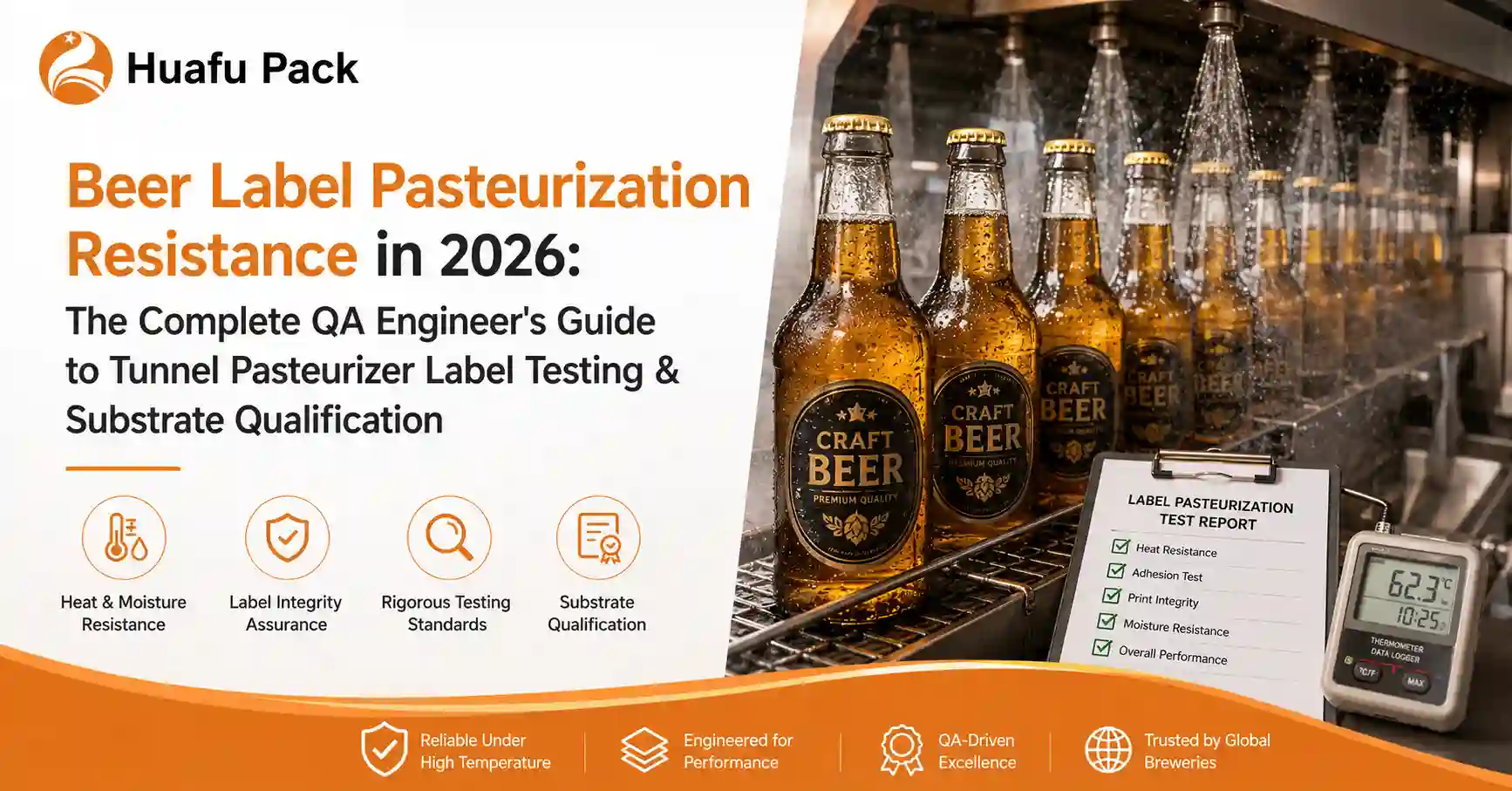
This guide is written for brewery QA engineers and packaging qualification managers who need to close that gap. It covers the thermal and mechanical stress mechanisms that cause label failure after pasteurization, the substrate parameters that determine whether a metallized beer label passes or fails the tunnel pasteurizer test, and the complete dual-stress qualification protocol that simultaneously validates cold water and heat performance — because in commercial brewing, a label that survives one environment but fails the other is not a label at all.
📑 QA Engineering Guide — Contents
What a Tunnel Pasteurizer Actually Does to a Beer Label: The Physics of Failure
The Four Distinct Pasteurization Label Failure Modes — and Their Root Causes
The Dual-Stress Challenge: Passing Both Ice Bucket and Pasteurizer Simultaneously
How to Specify Pasteurization-Resistant Metallized Paper from a Supplier
FAQ: QA Engineering Questions, Answered at Specification Depth
1. What a Tunnel Pasteurizer Actually Does to a Beer Label: The Physics of Failure
A tunnel pasteurizer is fundamentally a controlled thermal stress machine. Its purpose is to apply sufficient heat energy to the filled, sealed bottle to achieve a target Pasteurization Unit (PU) count — typically 15–25 PUs for most commercial lager and ale products — which inactivates spoilage microorganisms without damaging the beer's flavor profile. The engineering trade-off is precise: enough heat to guarantee microbiological stability, not so much that the product or packaging degrades.
From the label's perspective, the tunnel pasteurizer creates four simultaneous stress conditions that don't exist in any other point of the label's operational life:
Sustained hot water spray at 60–65°C for 20–35 minutes. This is not the brief thermal exposure of a hot fill or a flash pasteurization process. It is continuous, sustained wet heat — long enough to drive moisture progressively deeper into the paper fiber structure and fully saturate any barrier coating that lacks sufficient thermal stability.
Progressive thermal cycling through warm-up and cool-down zones. Most tunnel pasteurizers run a temperature profile — gradual warm-up from ambient to peak pasteurization temperature, sustained hold at peak, then gradual cool-down before bottles exit. This thermal cycling creates repeated expansion and contraction stress at every adhesive interface in the label construction: base paper fiber, aluminum layer, top coating, adhesive layer, and glass substrate.
Water pooling at the bottle base and label lower edge. Gravity concentrates hot water at the lowest point of the bottle during the spray cycle. The bottom third of the label receives the longest effective moisture contact time — which is exactly where label blistering concentrates in the failure mode described in the opening scenario.
Mechanical handling stress concurrent with thermal stress. Bottles move through the tunnel on conveyor systems. The combination of thermal softening of adhesive bonds and concurrent mechanical vibration creates peel stress at the label edges that an adhesive system softened by 62°C water exposure may not withstand.
Understanding these four simultaneous stress conditions is the starting point for understanding why the standard ambient tape test and cold water immersion test — both of which most label substrates pass without difficulty — are entirely insufficient as qualification tests for pasteurization applications. They test one stress condition at a time, at room temperature or below. The tunnel pasteurizer applies all four simultaneously, at elevated temperature. The failure modes are fundamentally different.
2. The Four Distinct Pasteurization Label Failure Modes — and Their Root Causes
When a QA engineer pulls a bottle from the pasteurizer exit and identifies a label quality failure, the visual symptom tells you which component of the label construction failed — but not why. Distinguishing between the four failure modes is critical, because each has a different root cause and a different corrective action. Treating all pasteurization label failures as a single problem type leads to the wrong substrate change and the same failure repeating on the next production run.
Failure Mode 1: Label Blistering (Subsurface Moisture Intrusion)
Appearance: Raised, dome-shaped blisters across the label face, typically concentrated in the lower third. The label surface has not delaminated from the bottle — it is still adhesively attached — but the paper fiber structure has absorbed sufficient moisture to cause internal steam pressure buildup between the paper layers during the heat phase.
Root cause: Insufficient wet-strength resin cross-linking in the base paper, combined with a Cobb value above the threshold for the applied PU specification. The paper fiber swells with absorbed moisture. Steam pressure from the heated moisture finds no path to escape and lifts the paper surface internally.
Substrate fix: Increase wet-strength resin loading in base paper specification. Target Cobb60 ≤20 g/m² for standard pasteurization applications. For high-PU specifications (≥20 PU at ≥63°C), target Cobb60 ≤15 g/m².
Failure Mode 2: Aluminum Layer Delamination (Coating Adhesion Failure)
Appearance: The metallic aluminum layer separates from the base paper, creating a frosted or matte zone where the mirror-bright metallic surface was. In severe cases, the aluminum layer detaches entirely in discrete patches, leaving the raw paper surface exposed. Often occurs simultaneously with blistering but can occur independently.
Root cause: The adhesion between the vacuum-deposited aluminum layer and the base paper (or between the aluminum layer and the top coating) is insufficient to withstand the combination of thermal expansion mismatch and moisture-driven swelling. Different materials expand at different rates when heated. If the adhesion energy at the aluminum-paper interface cannot accommodate the differential strain, delamination initiates at the weakest point — often at a moisture-infiltration site at the label edge.
Substrate fix: Specify aluminum layer deposition with a primer bonding layer between the paper surface and the aluminum. Request a pasteurization adhesion test result (not just ambient tape test) in the supplier's technical data sheet. The aluminum layer adhesion must be verified under thermal stress conditions, not ambient conditions.
Failure Mode 3: Ink Dropout and Overprint Varnish Crazing (Top-Coating Thermal Degradation)
Appearance: Ink colors appear faded, cracked, or crazed — a fine network of micro-cracks in the overprint varnish surface, making the label look aged or poorly produced. In severe cases, ink detaches from the varnish surface in discrete flakes. Typically most visible in areas of dense ink coverage.
Root cause: The overprint varnish (OPV) applied by the label converter has insufficient glass transition temperature (Tg) for the sustained thermal exposure. Most standard UV-cured OPVs are formulated for ambient and cold water applications. Their polymer network begins to soften and restructure above 55–58°C. A 62°C pasteurizer sustained for 28 minutes takes the varnish polymer above its Tg for the entire process dwell time, causing irreversible surface changes.
Corrective action: This is primarily a label converter specification issue rather than a substrate issue. The converter must select an OPV with a verified Tg above 70°C for pasteurization applications — providing a 5–8°C safety margin above peak process temperature. Confirm OPV Tg in writing from your converter before approval.
Failure Mode 4: Full Label Detachment (Adhesive Cohesive Failure)
Appearance: The entire label or a substantial portion detaches from the bottle surface during or after the pasteurizer cycle. The glass surface is clean or carries a thin adhesive film residue. This is the most severe failure mode and the most visible during production-line inspection.
Root cause: The wet-glue or pressure-sensitive adhesive system has insufficient thermal cohesive strength for the sustained hot water exposure. Wet-glue adhesives for pasteurization applications must maintain adequate viscosity and cohesive strength at 62–65°C. Standard cold-temperature wet-glues (designed for ice bucket performance) are formulated to maintain adhesion in cold water — their thermal performance ceiling is often well below pasteurization temperature.
Corrective action: Specify a dual-temperature wet-glue adhesive — one formulated to maintain cohesive strength from 2°C (ice bucket) to 65°C (pasteurizer upper limit). These adhesive systems exist as a specific product category in the wet-glue market. They are more expensive than single-temperature adhesives. They are cheaper than a 180,000-label rework event.
📖 For the ice bucket cold-water performance side of the dual-stress equation: Why Wet Strength Metallized Paper Is Crucial for Beer Labels in 2026
3. The Substrate Parameters That Determine Pass or Fail
Once a QA engineer understands which failure mode they are dealing with, the conversation with the substrate supplier needs to move immediately to measurable, testable parameters — not to marketing claims about "pasteurization-grade" or "brewery-approved" materials. Every parameter listed below should be available in a supplier's technical data sheet and confirmed in the per-batch Certificate of Analysis (COA). If it is not in the COA, it has not been verified for the batch you are using.
| Substrate Parameter | Standard Beer Label Spec | Pasteurization Grade Spec | Why It Matters for Pasteurization |
|---|---|---|---|
| Cobb60 Value | ≤25 g/m² | ≤20 g/m² (standard PU) ≤15 g/m² (high PU ≥20 PU at ≥63°C) | Controls moisture penetration rate into base paper fibers. Lower Cobb value = slower moisture ingress = less blistering risk under sustained hot water spray. |
| Wet Tensile Strength (Machine Direction) | ≥1.0 kN/m | ≥1.4 kN/m | Paper must maintain structural integrity under simultaneous moisture saturation and mechanical conveyor stress. Low wet tensile strength results in label tearing at conveyor contact points during pasteurizer exit. |
| Aluminum Layer Optical Density (OD) | ≥2.8 | ≥2.8 (unchanged — deposition thickness, not thermal issue) | Aluminum layer thickness affects delamination resistance indirectly — thicker, denser deposition provides marginally more resistance to interface stress. OD ≥2.8 ensures adequate deposition density. |
| Top Coating Thermal Stability | Ambient performance verified | Verified stable at 65°C for 35 minutes (over-specification of process maximum) | Standard top coating polymer may soften above 58°C. Pasteurization-grade top coating must maintain surface hardness, ink adhesion, and aluminum layer bond integrity at peak process temperature plus 5°C safety margin. |
| Surface Tension (Dyne Level) Post-Pasteurization | ≥38 dyne/cm (pre-print) | Must be verified pre-print AND confirmed stable after pasteurization simulation (no reduction >3 dyne/cm) | Pasteurization thermal cycling can alter top coating surface chemistry. Post-pasteurization dyne level drop indicates top coating degradation — a leading indicator of ink adhesion failure on future production runs. |
| Wet-Strength Resin Type | Standard polyamidoamine-epichlorohydrin (PAE) resin | High-temperature PAE resin with enhanced cross-link density, or thermally-stable polyamide resin system | Standard PAE resins provide cold-water wet strength but their cross-link stability degrades above 60°C under prolonged exposure. High-temperature variants maintain cross-link integrity through full pasteurization cycle. |
4. The Dual-Stress Challenge: Passing Both Ice Bucket and Pasteurizer Simultaneously
Here is the design tension that makes pasteurization-grade label substrate specification genuinely difficult, and why it cannot be solved by simply specifying "high performance" without defining performance against both stress environments explicitly.
The ice bucket test and the tunnel pasteurizer test pull substrate performance in opposite directions in one critical parameter: moisture barrier behavior.
The ice bucket requires the label to resist moisture absorption from outside — cold water pooling around the bottle must not penetrate the paper fiber structure rapidly enough to compromise adhesive bond or structural integrity. The design response is to maximize the barrier properties of the top coating and base paper: high Cobb resistance, dense top-coating polymer, strong surface barrier.
The tunnel pasteurizer creates the opposite requirement in one key respect. When hot moisture does inevitably penetrate into the paper fiber structure during a sustained 30-minute heat exposure, the resin cross-links within the paper must maintain structural integrity under simultaneous heat and moisture stress. A paper with an extreme external moisture barrier but a fragile internal wet-strength system can actually perform worse in a pasteurizer than a paper with moderate external barrier properties but a robust high-temperature wet-strength resin system — because once moisture does penetrate at the label edge during the sustained heat cycle, the internal fiber structure has no thermal wet-strength reserve to prevent blistering.
The dual-stress solution is not about maximizing a single parameter. It is about the specific combination of:
Sufficient external moisture barrier (Cobb60 ≤20 g/m² for pasteurization grade) to slow moisture ingress to a rate the internal resin system can manage across the full pasteurization dwell time
High-temperature wet-strength resin system that maintains cross-link integrity at ≥65°C for the full dwell time, even after moisture does penetrate during the cycle
Thermally-stable top coating that does not soften, delaminate, or change surface chemistry during the thermal cycle — protecting both aluminum layer adhesion and ink adhesion integrity post-pasteurization
Dual-temperature adhesive system selected by the label converter for the complete temperature range from 2°C (ice bucket) to 65°C (pasteurizer peak) — this is the converter's specification responsibility, but the substrate supplier must provide the correct substrate surface chemistry for the chosen adhesive system to bond to reliably across that full range
When all four of these elements are correctly specified and verified together, a vacuum metallized paper beer label can routinely pass both 72-hour ice bucket immersion and full-specification tunnel pasteurizer simulation in the same qualification sequence. This is not a theoretical capability — it is a verified production reality for commercial breweries running both cold-channel and pasteurized SKUs with a single substrate specification.
📖 Full substrate comparison including pasteurization performance across all three major beer label substrates: Metallized Paper vs. Foil Label vs. BOPP: The Complete Beer Label Substrate Comparison Guide for 2026
5. The Complete Dual-Stress Substrate Qualification Protocol
This is the section most QA engineers will print, annotate, and keep. What follows is a sequential qualification protocol that covers both stress environments in a single test programme, generates documentation suitable for internal approval and supplier audit purposes, and provides clear go/no-go decision criteria at each stage. It can be run entirely with commercially available laboratory equipment and standard materials — no specialist facilities required.
Phase 1 — Incoming Substrate Verification (Pre-Print, Pre-Adhesive)
Step 1.1 — Cobb Value (ISO 535)
Measure water absorption per ISO 535 at 60-second exposure (Cobb60). Test five specimens per roll — both face and back — at three positions across web width. Accept: ≤20 g/m² for standard pasteurization. ≤15 g/m² for high-PU specification. Document: substrate batch number, roll number, test date, operator, all fifteen individual results.Step 1.2 — Wet Tensile Strength (TAPPI T456 or ISO 3781)
Test wet tensile strength in machine direction (MD) and cross direction (CD) after 60-second water immersion. Accept: MD ≥1.4 kN/m for pasteurization grade. CD should be ≥0.8 kN/m. Reject rolls below threshold — do not attempt to compensate with press-side parameters.Step 1.3 — Surface Tension / Dyne Level (ISO 8296)
Measure dyne level at three cross-web positions per incoming roll. Accept: ≥38 dyne/cm uniform. Flag: variation >2 dyne/cm across web width — indicates uneven corona treatment. Document for lot traceability.Step 1.4 — OD Value (Macbeth Densitometer or Equivalent)
Confirm aluminum layer optical density ≥2.8 at five measurement points across roll width. Low OD is a leading indicator of thin aluminum deposition and potentially weaker aluminum-paper interfacial adhesion under thermal stress.
Phase 2 — Print and Converting Qualification
Step 2.1 — Proof Print and Ambient Tape Test (ASTM D3359 Method B)
Print full-colour proof at production speed. After 30-minute UV cure stabilization, apply 3M 610 tape cross-hatch. Accept: ≥4B rating (≤5% ink removal). Document press parameters — ink viscosity, UV lamp intensity, anilox BCM — for production comparison baseline.Step 2.2 — OPV Tg Verification
Request the glass transition temperature (Tg) data sheet from your label converter for the specific overprint varnish selected for this job. Accept: Tg ≥70°C. If converter cannot provide Tg data, request a change to a converter who can. This is a specification-critical data point, not an optional quality nicety.
Phase 3 — Cold Water Immersion Test (Ice Bucket Simulation)
Step 3.1 — 72-Hour Ice Water Immersion
Apply fully printed and varnished label samples to clean glass test bottles using the production wet-glue adhesive system and application parameters. Immerse labeled bottles completely in water at 2–4°C for 72 hours. Remove, pat dry with lint-free cloth, inspect within 10 minutes of removal.Step 3.2 — Post-Immersion Assessment Criteria
Accept: Zero blistering. Zero aluminum layer separation. Ink adhesion tape test ≥4B (ASTM D3359). Label adhesion — no lifting or edge peeling. Any single failure criterion triggers phase review — do not proceed to Phase 4 until cold water performance is confirmed.
Phase 4 — Tunnel Pasteurization Simulation (Core Qualification Test)
Step 4.1 — Pasteurizer Simulation Setup
If a full tunnel pasteurizer is not available for laboratory qualification, a hot water immersion bath can simulate the sustained thermal exposure component with acceptable correlation. Target: water temperature at your process specification +3°C safety margin (e.g., 65°C for a 62°C process specification). Immersion duration: your specified dwell time +10% (e.g., 31 minutes for a 28-minute process). Bottles must be fully submerged, not floating — weight them if necessary. This eliminates the spray impingement component but captures the thermal-moisture stress that drives the majority of label failure modes.Step 4.2 — Preferred Method: Actual Tunnel Pasteurizer Trial Run
For formal substrate approval for commercial production, the preferred qualification method is a trial run on the actual pasteurizer at your brewery, using your production-specification PU target and temperature profile. This captures all four simultaneous stress conditions described in Section 1. Run minimum 500 bottles. Inspect 100% for the first 50 bottles, then 10% sampling for the remainder. Document time in tunnel, peak temperature, PU count achieved, and any label anomalies observed at each inspection point.Step 4.3 — Post-Pasteurization Assessment Criteria
Accept: Zero blistering across any label zone. Zero aluminum delamination. Zero ink dropout or OPV crazing. Label adhesion — no edge lifting. Post-pasteurization tape test ≥4B (ASTM D3359 — repeat test after 2-hour stabilization post-pasteurizer). Post-pasteurization dyne level — measure surface tension of pasteurized label face; acceptable maximum reduction from pre-print dyne level: 3 dyne/cm.
Phase 5 — Dual-Stress Sequential Test (The Final Gate)
Step 5.1 — Cold-Then-Hot Sequential Stress
After a separate set of labeled test bottles passes Phase 3 cold water immersion, transfer immediately to the pasteurization simulation (Phase 4 protocol). The sequential exposure is more aggressive than either test in isolation because the paper fiber structure enters the thermal exposure already partially moisture-saturated from the cold immersion phase. This is a realistic simulation of a labeled bottle that has spent time in a cold distribution chain before pasteurization — not uncommon in breweries that label in advance of a production batch going into short-term cold storage before pasteurization processing.Step 5.2 — Hot-Then-Cold Sequential Stress
Run the pasteurization simulation first, then transfer pasteurized bottles to the 24-hour cold water immersion. This simulates the opposite distribution scenario — pasteurized product entering a cold retail environment. Assessment criteria identical to Step 4.3 and Step 3.2 respectively.
6. How to Specify Pasteurization-Resistant Metallized Paper from a Supplier
The most common substrate qualification failure is not a bad substrate — it is an imprecise specification. A QA engineer who sends an RFQ that reads "metallized paper for beer labels, pasteurization resistant" will receive samples that are marketed as pasteurization-resistant but may or may not meet the specific parameters required for their application. The specification needs to be written in parameter language, not marketing language.
Here is the complete specification block that should accompany any RFQ for pasteurization-grade metallized beer label paper:
| Specification Parameter | Minimum Acceptable Value | Test Method / Reference Standard |
|---|---|---|
| Base Paper Grammage (GSM) | Per application (specify: e.g., 80 gsm ±3 gsm) | ISO 536 |
| Cobb60 Value (Face Side) | ≤20 g/m² (standard PU) / ≤15 g/m² (high PU) | ISO 535 |
| Wet Tensile Strength — MD | ≥1.4 kN/m after 60s water immersion | TAPPI T456 / ISO 3781 |
| Aluminum Layer Optical Density (OD) | ≥2.8 (measured at 5 cross-web positions) | Macbeth/X-Rite densitometer |
| Surface Tension (Dyne Level) | ≥38 dyne/cm at point of manufacture; variation ≤2 dyne/cm cross-web | ISO 8296 / ASTM D2578 |
| Top Coating Thermal Stability | Verified stable at 65°C for 35 minutes: no OD change >0.2, no surface tension change >3 dyne/cm | Supplier internal test — request written data |
| Wet-Strength Resin System | High-temperature PAE or thermally-stable polyamide resin. Supplier to confirm resin type and thermal performance ceiling in writing. | Supplier declaration — request in COA |
| COA Documentation per Production Batch | Cobb60, wet tensile MD/CD, OD value, surface tension, caliper — confirmed for every production batch shipped | Supplier COA document — request template before first order |
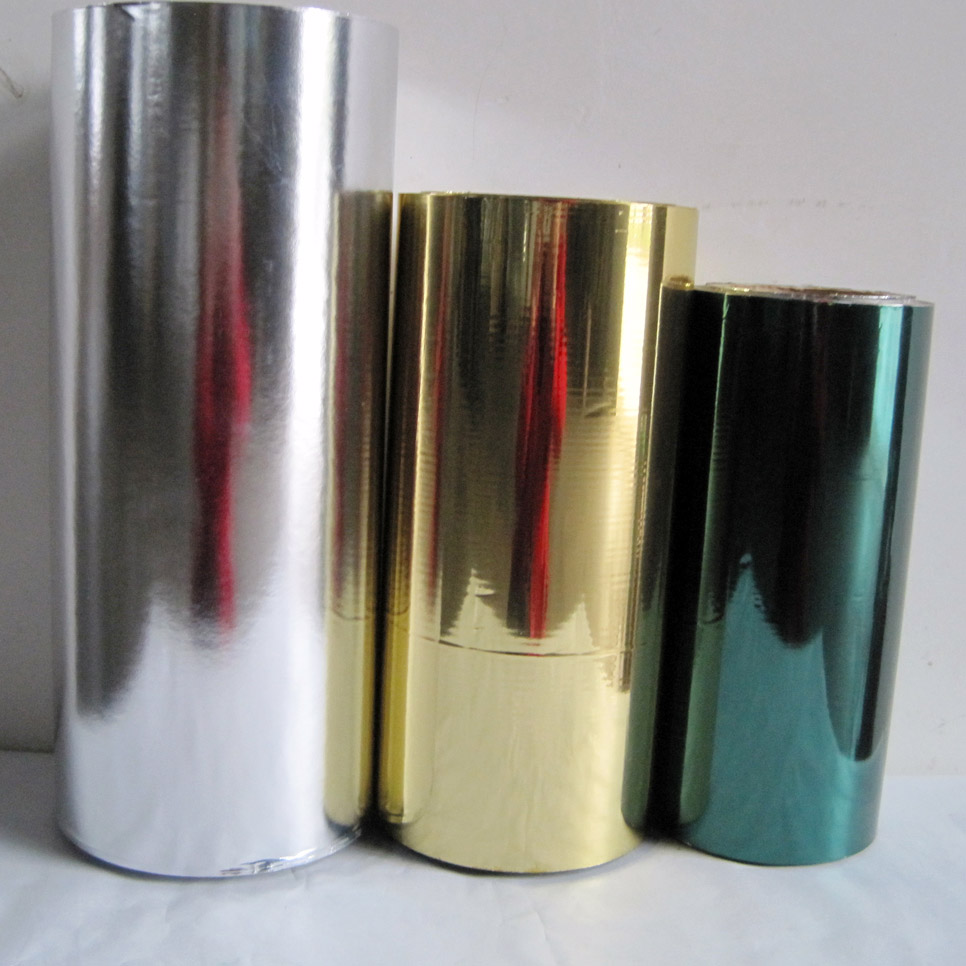
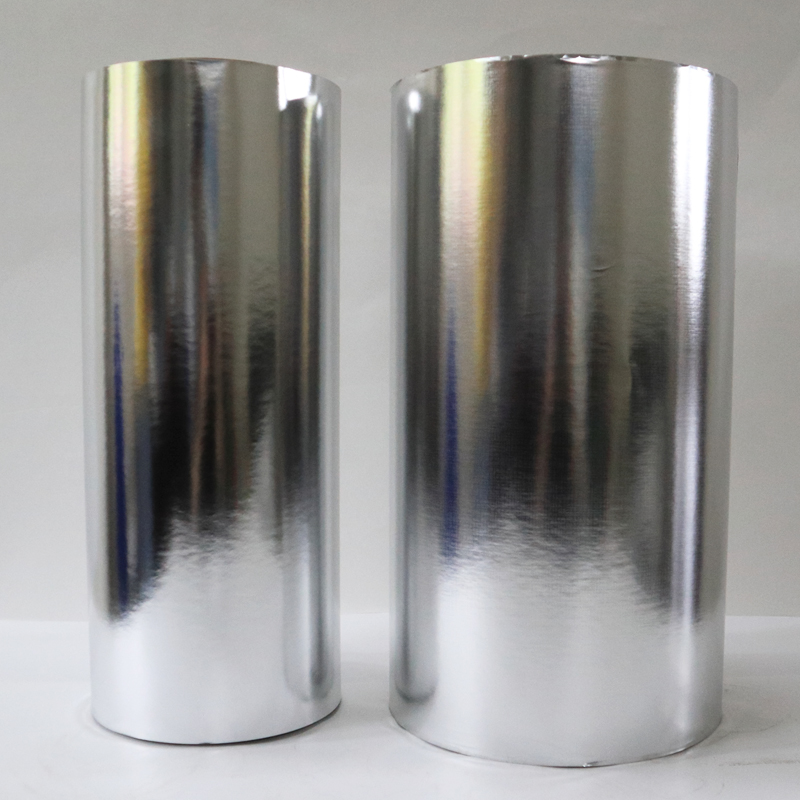
At Huafu Pack, we manufacture pasteurization-grade metallized paper variants for commercial brewery clients running tunnel pasteurizer processes. Our export team — Susan, Vivian, and Janet — can provide a pre-populated specification template for your RFQ process, alongside sample COA documentation and technical data sheets for the specific substrate variant matched to your PU target and pasteurizer temperature profile. OEM trial samples in your specified width and core diameter are ready in 15 days.
7. FAQ: QA Engineering Questions, Answered at Specification Depth
A: For a 20+ PU process at temperatures approaching 65°C with dwell times above 30 minutes, vacuum metallized paper can achieve qualification — but it requires the high-PU specification: Cobb60 ≤15 g/m², wet tensile ≥1.4 kN/m MD, high-temperature PAE resin system, and thermally-stable top coating verified at 65°C for 35 minutes. It also requires a formal tunnel pasteurizer trial run on your actual process, not just a laboratory hot-water bath simulation. The honest answer is: foil laminate has a higher thermal performance ceiling with less specification sensitivity. For the highest-PU, highest-temperature pasteurization processes, foil laminate remains the technically safest choice. For processes up to approximately 20 PU at 62–63°C, correctly specified vacuum metallized paper is a qualified alternative — at meaningfully lower unit cost and with a better PPWR recyclability profile.
A: This is a common and legitimate dispute between breweries and converters, and the answer is in the failure mode. Adhesive cohesive failure produces full label detachment with the glass surface clean or carrying a thin adhesive residue film — the label-to-glass bond failed. Substrate failure produces blistering (paper fiber internal failure), aluminum delamination (coating-to-paper interface failure), or OPV crazing (top coating thermal failure) — the label remains adhered to the bottle but is visually damaged. In the scenario described in the opening of this article — blistering concentrated in the lower third of the label with the aluminum layer lifting but the label remaining on the bottle — the failure mode is unambiguously substrate-related, not adhesive-related. Document the failure mode visually before any rework, and map the failure location on the bottle (lower third indicates water pooling, therefore sustained moisture contact time) before drawing conclusions about the root cause.
A: Yes, and this is one of the most technically demanding substrate specifications in commercial brewing — but it is achievable with vacuum metallized paper when the specification is correctly written. The pasteurization requirement drives the substrate parameters (high-temperature wet-strength resin, low Cobb value, thermally-stable top coating). The caustic wash-off requirement is primarily an adhesive system and label construction specification — the wash-off adhesive must be selected to release cleanly in 80°C NaOH solution after having survived the pasteurization cycle. The substrate itself — paper-based vacuum metallized paper — is inherently more wash-off compatible than BOPP film or foil laminate, because the cellulose fiber structure allows the caustic solution to penetrate the paper and facilitate coherent sheet detachment. The combined specification requires qualification testing in the correct sequence: pasteurization simulation first, then caustic wash-off test on the same samples.
A: For a pasteurization-grade substrate order, a Huafu Pack COA includes the following confirmed parameters per production batch: (1) Substrate batch number and production date. (2) Base paper grammage (GSM) per ISO 536. (3) Cobb60 value (face side) per ISO 535. (4) Wet tensile strength MD and CD per TAPPI T456. (5) Aluminum layer OD value at five cross-web positions. (6) Surface tension (dyne level) at three cross-web positions per ISO 8296. (7) Caliper (thickness) per ISO 534. (8) Wet-strength resin system declaration — resin type and supplier. (9) Top coating thermal stability confirmation for the specified pasteurization temperature range. If your internal supplier qualification system requires additional documented parameters or a specific COA format, contact Susan, Vivian, or Janet with your requirements before placing the first order — we can align our COA documentation to your specification template.
No More Pasteurizer Surprises. Qualify the Substrate Before It Goes on the Line.
Contact Huafu Pack's technical export team with your PU specification, peak pasteurizer temperature, and dwell time. We will identify the correct pasteurization-grade metallized paper variant, provide the full technical data sheet and COA template, and supply free A4 qualification samples for your press trial and pasteurizer simulation programme.
📍 Xianning High-Tech Zone, Hubei Province, China | ✉️ sales@huafupacking.net | 📞 +86-13797805927
Mr. Xiao leads packaging quality systems development at Huafu Packing Material Co.,Ltd, Xianning. Over the past decade he has supported brewery QA teams and packaging qualification engineers across Europe, the Americas, and the Asia-Pacific in designing substrate qualification protocols for some of the most technically demanding label applications in commercial brewing — including dual-stress pasteurization and returnable bottle programs. He writes for engineers who need to solve real production problems, not for marketing presentations.
Technical References & Test Standards
ISO 535:2014 — Paper and board: Determination of water absorptiveness (Cobb method). Primary test standard for Cobb60 measurement in beer label substrate qualification.
TAPPI T456 om-15 — Wet tensile breaking strength of paper and paperboard. Machine direction wet tensile specification for pasteurization-grade label substrate.
ISO 3781:2011 — Paper and board: Determination of tensile strength after immersion in water. Cross-method reference for wet tensile specification.
ISO 8296:2003 — Plastics: Film and sheeting — Determination of wetting tension. Applied to metallized paper top-coat surface tension qualification pre- and post-pasteurization.
ASTM D3359-22 — Standard Test Methods for Rating Adhesion by Tape Test. Method B cross-hatch adhesion rating applied at ambient and post-pasteurization stages.
FINAT Technical Handbook (9th Edition) — Section 6.2: Heat resistance and pasteurization test protocols for self-adhesive label materials in beverage applications.
Krones AG Technical Documentation — Tunnel Pasteurizer Operating Parameters and PU Calculation Guidelines. Reference for PU accumulation model and label thermal stress profile characterization.
Huafu Packing Material Co.,Ltd — Pasteurization-Grade Substrate Qualification Records and Brewery Client Trial Data, Xianning Facility, 2015–2026.