Metallized Beer Label Paper Price in 2026

Published: July 2026 | 11 min read | Audience: SME Print Shop Owners & First-Time China Importers
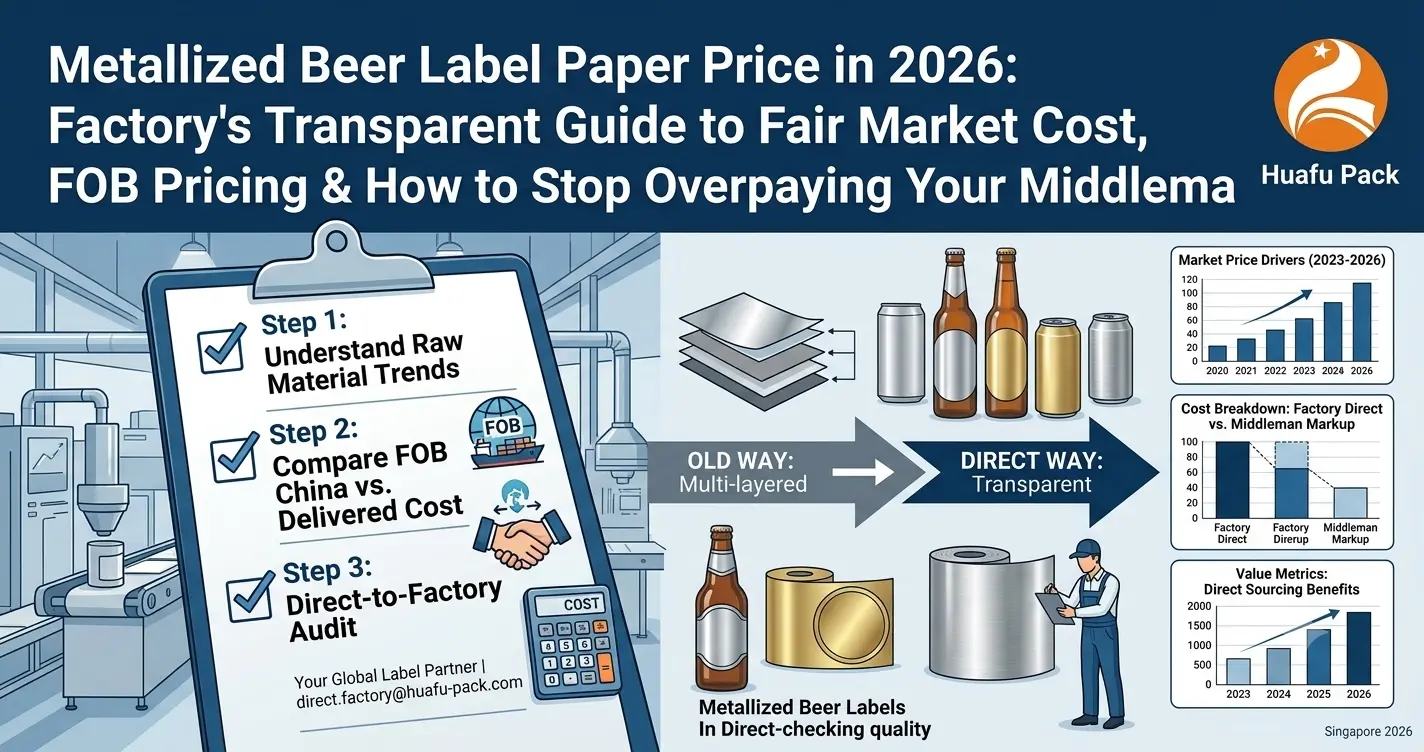
Last quarter, a label print shop owner in Eastern Europe sent me three quotes he had collected for the same product: vacuum metallized beer label paper, silver, 80 gsm, standard roll. The three prices — all from Chinese suppliers, all responding to the same RFQ — differed by 47%. The cheapest was $1,680 per metric ton. The most expensive was $2,470 per metric ton.
He wanted to know which one was real.
The honest answer is: all three were real. The 47% spread is not evidence of fraud. It is evidence of something more common and more expensive — a market where buyers lack the reference framework to distinguish fair pricing from inflated pricing, and where the information asymmetry almost always favors the seller.
The buyer who picks the lowest quote without understanding why it is low will sometimes get lucky. More often, they will receive a batch of metallized paper with a Cobb value above specification, an OD value below 2.5, and a surface tension so low that their press technician spends two shifts troubleshooting ink adhesion failures before tracing the problem back to the substrate. The buyer who picks the highest quote has simply paid a trading company margin on top of the actual factory price — money that went directly into a middleman's pocket.
This article does something that most Chinese suppliers are unwilling to do: it explains the actual cost structure of metallized beer label paper, what drives the price up or down at each stage of the manufacturing process, what a fair FOB China price looks like in 2026, and exactly how to read a quote to tell whether you are dealing with a manufacturer or an intermediary. By the end of it, you will have a working reference framework that protects you from both traps.
📑 Pricing Guide — Contents
The Real Cost Structure of Metallized Beer Label Paper: Four Manufacturing Layers
The Six Variables That Legitimately Move the Price Up or Down
2026 FOB China Price Reference Ranges by Specification Grade
Five Signals That Tell You a Quote Comes from a Middleman, Not a Factory
The Real Cost of the Cheap Quote: What Under-Spec Substrate Actually Costs You
How to Negotiate Factory-Direct Pricing That Is Both Fair and Sustainable
1. The Real Cost Structure of Metallized Beer Label Paper: Four Manufacturing Layers
Before you can evaluate a price, you need to understand what you are actually paying for. Metallized beer label paper is not a commodity like uncoated paper roll. Every unit of price reflects decisions made at four distinct manufacturing stages, and each stage contributes to both cost and performance.
Layer 1: Base Paper — The Foundation Cost
The base paper is the single largest cost component in a finished roll of metallized beer label paper — typically accounting for 45–55% of the total manufacturing cost. Base paper for beer label applications is not generic printing paper. It requires:
A specific grammage (GSM) matched to the label application — 60 gsm for lightweight neck labels, 80 gsm for standard front and back labels, up to 120 gsm for premium heavyweight applications
Wet-strength resin treatment — either standard PAE resin or high-temperature PAE resin for pasteurization-grade applications
A controlled surface smoothness that allows aluminum vapor to deposit uniformly during vacuum metallization
Consistent caliper (thickness) tolerance — typically ±3 gsm for roll-to-roll converting reliability
Base paper of this specification is more expensive than commodity printing paper by a meaningful margin. A supplier quoting a price that would only be possible with a commodity paper base is telling you something important about what is — and is not — inside their roll.
Layer 2: Vacuum Metallization — The Process Cost
The vacuum metallization chamber is the most capital-intensive piece of equipment in a metallized paper facility. The aluminum vapor deposition process — evacuating a chamber to near-vacuum, heating aluminum wire in tungsten boats, depositing the evaporated aluminum onto the paper web — consumes significant electrical energy and requires precise process control to deliver consistent optical density (OD) values across the full web width and along the full roll length.
The aluminum material cost itself is relatively modest — the aluminum layer is only 25–40 nanometers thick, and even a high-volume production run uses very little aluminum by weight. The real cost is the chamber time, the electrical energy, the tungsten boat replacement schedule, and the quality control overhead of verifying OD uniformity across every batch.
A facility operating at high capacity utilization with modern chamber equipment can produce metallized paper at a lower per-ton chamber cost than a facility running older equipment at low utilization. This is one legitimate reason why prices differ between suppliers with different equipment profiles.
Layer 3: Top Coating — The Performance Cost
The top coating applied over the aluminum layer is where the most significant performance differentiation between substrate grades occurs — and it is the cost component that is most tempting for low-price suppliers to compress. The top coating formulation determines:
Surface tension (dyne level) — the primary determinant of ink adhesion performance
Thermal stability — whether the coating survives pasteurization without Tg-related surface degradation
Moisture barrier contribution — the top coating's polymer density contributes to Cobb value performance alongside the base paper wet-strength system
OPV compatibility — whether the coating surface accepts the overprint varnish systems used by label converters without adhesion failure
A standard top coating formulation designed for ambient and cold-water applications costs less than a thermally-stable pasteurization-grade coating formulation. A coating that delivers ≥38 dyne/cm with ≤2 dyne/cm cross-web variation costs more to apply consistently than one that achieves 36 dyne/cm with variable uniformity. These differences are invisible in a product photograph and invisible in a marketing description. They are visible only in a per-batch COA and in your production spoilage rate.
Layer 4: Slitting, Winding & Finishing — The Conversion Cost
The finished roll width, core diameter, roll diameter, and packaging format all carry a conversion cost. Custom-width slitting for a specific press web width requires a dedicated slitting run. Smaller roll diameters mean more changeovers per ton on the converting press and slightly higher waste generation. Double-wound rolls or special packaging for long-distance ocean freight add further cost. These are legitimate cost adders that should be visible in a supplier's quote breakdown — and a supplier who cannot explain why a custom width costs more than a standard width is not a supplier with genuine manufacturing depth.
2. The Six Variables That Legitimately Move the Price Up or Down
Not every price difference between suppliers is evidence of middleman markup or quality compromise. Six specification variables create genuine, legitimate cost differences between two rolls of metallized beer label paper that might otherwise look identical in a product description. Understanding these variables lets you evaluate whether a price difference is explained by specification or by margin.
Variable 1: Base Paper Grammage (GSM)
Price scales approximately linearly with GSM for the base paper component. An 80 gsm substrate costs more than a 60 gsm substrate. A 100 gsm substrate costs more than an 80 gsm substrate. The relationship is not perfectly linear because heavier paper moves through the metallization chamber at different speeds, affecting chamber utilization cost — but grammage is the most transparent and most predictable cost driver in the substrate specification.
Variable 2: Optical Density (OD) Target
Achieving OD ≥2.8 uniformly across the web width and along the roll length requires more careful process control than achieving OD ≥2.5. Higher OD target specifications increase chamber run time slightly (thicker deposition requires more passes or slower web speed through the aluminum vapor) and increase quality control overhead. An OD ≥3.0 specification for mirror-finish holographic applications costs more than an OD ≥2.8 standard specification.
Variable 3: Wet-Strength Resin Grade
Standard PAE resin is less expensive than high-temperature PAE resin or specialty thermally-stable resin systems. A pasteurization-grade substrate specification — requiring high-temperature resin — has a higher base paper cost than a standard cold-water-only specification. This cost difference is real and legitimate. A supplier quoting the same price for a "standard" substrate and a "pasteurization-grade" substrate is either not differentiating the base paper specification (in which case your pasteurization performance will be standard, not grade-specific) or is absorbing a cost difference they will recover elsewhere.
Variable 4: Custom Roll Dimensions
Standard width rolls (typically 1,000mm, 1,100mm, or 1,300mm full web widths before slitting) carry the lowest per-ton conversion cost. Custom slit widths — for example, 790mm for a specific press web — require a dedicated slitting run, which may generate edge-trim waste and requires machine setup time. Core diameter specifications (76mm, 152mm, 300mm) and maximum roll diameter specifications all affect winding machine setup and packaging cost. Custom roll dimensions are a legitimate cost adder of 3–8% depending on the degree of departure from standard configurations.
Variable 5: Order Volume (MOQ and Annual Volume Commitment)
Metallized paper manufacturing has meaningful economies of scale in chamber utilization, base paper purchasing, and coating material procurement. A 20-ton order runs more cost-efficiently than a 2-ton trial order. An annual commitment of 100+ tons with regular scheduled shipments allows the manufacturer to plan production and raw material purchasing more efficiently than spot orders. The difference between a 2-ton trial price and a committed annual volume price can be 8–15% on unit cost — and this is a negotiating lever that first-time importers consistently underuse.
Variable 6: Special Effects Specification
Holographic embossed variants carry a price premium over standard silver metallized paper — the nickel master shim for the embossing process represents a capital investment, the embossing process step adds machine time, and the yield rate for holographic paper is typically slightly lower than for standard metallized paper due to the tighter quality control requirements. Gold color metallized paper — which requires an additional tinting coating step — sits between standard silver and holographic in price. Rainbow color metallized variants require additional coating color passes and carry the highest price within the standard product range.
3. 2026 FOB China Price Reference Ranges by Specification Grade
The following price reference ranges reflect current 2026 market conditions for factory-direct FOB Qingdao / Shanghai pricing from established Chinese metallized paper manufacturers with verifiable production facilities. These are not artificially low promotional prices and they are not inflated market prices. They represent what a genuine manufacturer quotes to a serious import buyer at commercial order volumes.
All prices are expressed in USD per metric ton, FOB China main port. Exchange rate fluctuations, shipping surcharges, and import duty in the destination country are not included.
| Product Grade & Specification | FOB Price Range (USD/MT) | Typical MOQ | Key Spec Indicators at This Price Point |
|---|---|---|---|
| Standard Silver Metallized Paper 60–80 gsm, OD ≥2.8, standard Cobb (≤25 g/m²) | $1,600 – $2,000 | 2 MT per width | COA per batch, surface tension ≥38 dyne/cm, standard wet-strength resin, ambient + cold water qualified |
| Wet-Strength Grade (Standard PU) 80 gsm, Cobb60 ≤20 g/m², standard PU pasteurization | $2,000 – $2,400 | 2 MT per width | Wet tensile MD ≥1.4 kN/m, thermally-stable top coating declared in COA, pasteurization simulation data available |
| High-PU Pasteurization Grade 80–100 gsm, Cobb60 ≤15 g/m², ≥20 PU at ≥63°C | $2,400 – $2,900 | 2 MT per width | High-temperature PAE resin declared, top coating Tg ≥70°C confirmed, full tunnel pasteurizer qualification data |
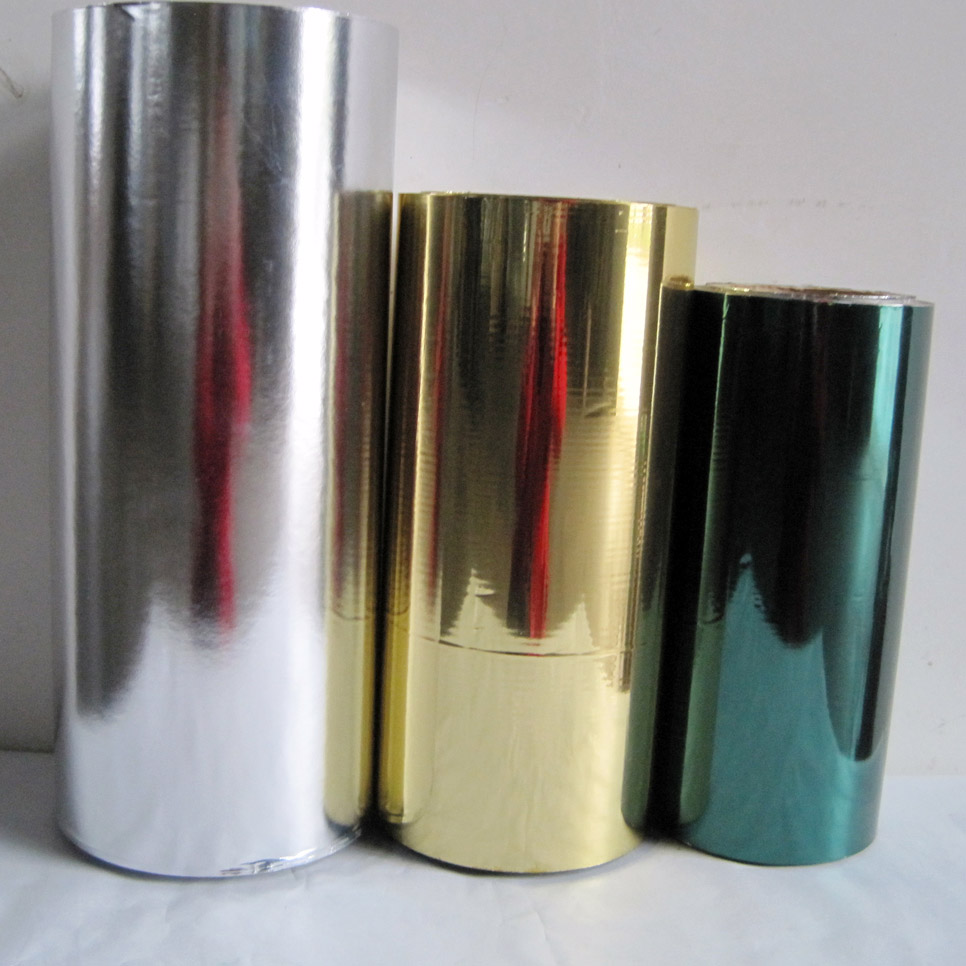
| Gold Metallized Paper Any gsm, gold tinting coating layer, OD ≥2.8 | $1,800 – $2,200 | 2 MT per width | Additional tinting coating step cost premium ~10–15% over equivalent silver grade |
| Standard Holographic Metallized Paper Rainbow linear / starburst / fine grain patterns | $2,200 – $2,800 | 2 MT per pattern per width | Embossing shim generation documented in batch record, cross-web OD uniformity ≥2.8, pattern consistency verified |
| Custom Color / Special Effects OEM color specification, multi-coating process | $2,500 – $3,500+ | 5 MT minimum (custom tooling amortization) | Color profile development fee may apply. 15-day OEM sample development before production commitment. |
📖 Understanding what technical specifications determine which price tier applies to your requirement: Metallized Paper vs. Foil Label vs. BOPP: The Complete Beer Label Substrate Comparison Guide for 2026
4. Five Signals That Tell You a Quote Comes from a Middleman, Not a Factory
In China's packaging materials export market, the line between manufacturer and trading company is deliberately blurred. Trading companies use language — "factory price," "manufacturer direct," "no middleman" — that is designed to make buyers believe they are dealing with a producer. Sometimes they are technically affiliated with a factory through an investment or agency relationship. More often they are simply purchasing from the factory and reselling at a markup.
None of this is illegal. But it means you are paying 15–25% more than the factory price for a service layer — faster response times, English-language sales support, consolidated shipping coordination — that may or may not be worth that premium to you. Here are the five most reliable signals that distinguish a factory quote from a trading company quote.
Signal 1: They Cannot Answer Technical Process Questions Without a 24-Hour Delay
A genuine manufacturer has engineers on site who can answer specific production process questions immediately or within the same business day. Ask: "What is the specific wet-strength resin grade you use in the base paper, and who is your base paper supplier?" A factory can answer this. A trading company will say "let me check with our technical team" — and return the next day with an answer they obtained from the actual factory. The 24-hour delay is the tell.
Signal 2: Their Minimum Order Quantity Is Unusually High or Low
Genuine metallized paper manufacturers typically have minimum order quantities in the range of 2–5 metric tons per width specification — driven by the economics of setting up a slitting run. Trading companies sometimes quote unusually low MOQs (500 kg, "no minimum") because they are buying from a factory in smaller quantities and adding markup. Equally, some trading companies relay the factory's standard MOQ unchanged — so high MOQ alone is not a factory signal. But an unusually low MOQ with no price premium attached warrants investigation.
Signal 3: They Cannot Provide a Factory Inspection Invitation
A straightforward request — "Can we arrange a video call to see your production facility, specifically the vacuum metallization chamber?" — separates factories from trading companies immediately. A genuine manufacturer will confirm a video call date without hesitation and will be able to show you the chamber in operation, the coating line, and the slitting department. A trading company will make excuses: "our factory partner doesn't allow video visits," "the production line is currently shut for maintenance," or will offer a video of a facility that does not match the production capability they described in their product introduction.
Signal 4: The COA They Provide Is Generic, Not Batch-Specific
A genuine manufacturer issues a Certificate of Analysis for each production batch, with the batch number, production date, and specific measured values for that batch recorded. A trading company typically has access to a generic product specification sheet from the factory — one that shows target values rather than actual measured values, and does not carry a batch number. Request the COA for the specific batch you will receive, not a generic product data sheet. If they cannot provide a batch-specific COA, they do not have direct access to the factory's quality records.
Signal 5: Their Price Is Suspiciously Uniform Across All Specifications
A genuine manufacturer's price varies logically with specification changes: higher GSM costs more, pasteurization grade costs more, holographic costs more. If a supplier quotes you the same price for 60 gsm standard silver and 80 gsm pasteurization grade — or gives you a round-number price that does not change when you adjust specifications — they are not calculating from a cost model. They are working from a margin target applied to a single factory price they received, and they have no insight into why the specifications they are quoting actually cost what they cost.
5. The Real Cost of the Cheap Quote: What Under-Spec Substrate Actually Costs You
The temptation of the lowest quote is most dangerous for SME print shops and first-time importers — because both groups have less financial cushion to absorb the downstream cost of a bad substrate batch, and because both groups are least likely to have the incoming inspection protocols that catch quality problems before they reach the press.
Let's put numbers on what a low-quality, under-spec metallized paper batch actually costs a mid-size label print shop. These figures are realistic estimates based on common failure patterns — not worst-case scenarios.
| Failure Event | Direct Cost Estimate | How It Happens With Under-Spec Substrate |
|---|---|---|
| Press downtime — ink adhesion troubleshooting | $800 – $2,500 per incident | Surface tension below 34 dyne/cm triggers ink beading. 2–6 hours of press time consumed trying to adjust ink, anilox, and cure parameters before the substrate is identified as the cause. |
| Substrate spoilage — press waste on bad rolls | $600 – $3,000 per batch | Under-spec substrate runs partially through a production job before the quality issue is identified. The labels already printed cannot be used. The substrate is the cost, but the ink and press time on those labels are also lost. |
| Customer label rejection — brewery return | $2,000 – $15,000+ per incident | Labels that pass the print shop's visual inspection but fail at the brewery's application line (adhesion failure) or in the ice bucket (delamination) are returned at the print shop's cost. Finished goods value, reprint cost, and expedited delivery premium combine. |
| Emergency substrate replacement order | $500 – $1,500 premium | When a bad batch is identified mid-production, sourcing a replacement roll urgently from a local or premium-price supplier adds a cost premium above the standard procurement price. |
| Customer relationship damage | Unquantifiable — but real | A brewery that receives defective labels does not usually look for the root cause in the substrate. They look for a different label printer. One bad batch can end a customer relationship that took years to build. |
Now apply this to the original example. The label printer who chose the $1,680/ton quote over the $1,900/ton quote saved $220 per ton — approximately $440 on a 2-ton trial order. A single press downtime incident from ink adhesion failure costs more than that saving. A single customer rejection costs multiples of it. The cheap quote is not cheap. It is deferred cost.
📖 How to specify and test substrate quality before it reaches your press: Metallized Paper Printability: The Press Technician's Complete Guide to Ink Adhesion, Corona Treatment & Surface Tension
6. How to Negotiate Factory-Direct Pricing That Is Both Fair and Sustainable
Once you have identified a genuine factory — not a trading company — and you have a reference framework for what fair pricing looks like at your specification level, the negotiation conversation changes completely. You are no longer asking "can you go lower?" You are having a specific, informed conversation about the levers that actually move price without compromising quality.
Lever 1: Volume Commitment
The single most powerful pricing lever available to an SME buyer is an annual volume commitment. If your current consumption is 6 tons per year in irregular spot orders, proposing a 12-month purchase agreement for 6 tons in three scheduled shipments of 2 tons each gives the manufacturer forward planning visibility and raw material purchasing efficiency. In exchange for that commitment, a price reduction of 5–10% from the spot order price is a reasonable request — and a reasonable concession for a genuine factory to make.
The commitment does not need to be legally binding to be effective. A letter of intent stating your projected annual volume and planned shipment schedule is sufficient to initiate a volume-based pricing conversation with most established manufacturers.
Lever 2: Standard Roll Dimensions
If your press can accept a slightly wider or narrower web width than your current custom specification, ask the supplier what their standard production widths are. Ordering at a standard production width eliminates the dedicated slitting run cost and allows the manufacturer to supply you from regular production runs — which reduces both unit cost and lead time. Even a 10–20mm adjustment to roll width, if it aligns with a standard production width, can reduce unit cost by 3–5%.
Lever 3: Extended Lead Time
Rush orders and short lead times cost money in any manufacturing context. If you can commit to an 8–10 week lead time instead of a 4-week lead time, the manufacturer can schedule your production into their regular run plan rather than creating a priority slot. This is a low-cost concession for a buyer with adequate stock management and a meaningful cost reduction opportunity for the manufacturer — some of which they can pass back to you in the price.
Lever 4: Payment Terms
Most Chinese manufacturers quote prices on 30% deposit, 70% before shipment (T/T) terms as standard. If you have the financial capacity to offer 50% deposit with 50% before shipment — or in a trusted long-term relationship, 100% advance payment — this reduces the manufacturer's working capital cost and is a real financial value they can reflect in a pricing concession. Conversely, requesting extended credit terms (30-day or 60-day payment after BL) typically results in a price increase, not a decrease, because it shifts working capital risk to the manufacturer.
Lever 5: Transparent Specification — Not Upgraded Specification
One of the most common pricing errors made by first-time importers is requesting a higher specification than their application actually requires. If your beer labels go into cold retail channels only — no pasteurization, no returnable bottle program — specifying pasteurization-grade substrate is wasting money. Work with the supplier to match the substrate specification precisely to the most demanding requirement in your application, and no further. Every specification upgrade above what your application requires is a price increase with no performance return.
7. FAQ: Pricing Questions, Factory-Level Answers
A: This is a fair question and it deserves a direct answer rather than marketing language. Huafu Pack's pricing reflects a specific set of commitments: we manufacture at our own Xianning facility (no middleman layer), we provide per-batch COA documentation as standard (not as a premium option), we specify and declare our wet-strength resin system in our technical data sheets, and our surface tension specification is verified at three cross-web positions per batch. If the supplier quoting you a lower price can demonstrate the same COA documentation standard, the same resin chemistry transparency, and the same OD value uniformity guarantee — then their lower price may well be a better deal. If they cannot demonstrate those things, the price difference is explained by what is missing from the substrate, not by manufacturing efficiency. Request the COA from both suppliers and compare the documented parameters. Let the data make the argument.
A: The 2-ton MOQ is driven by the economics of the slitting and winding process — a slitting run for less than 2 tons at a specific width generates a setup cost that makes the per-ton price uneconomical for both parties. For a genuine first trial where you are evaluating the substrate for press qualification, we offer free A4 size samples of any standard product variant at no cost and no commitment. A4 samples are sufficient for: dyne level measurement, OD value check, Cobb value test (requires a larger sample — request a 1m x 0.5m cutting if needed), and laboratory ink adhesion testing. If the A4 evaluation passes, the 2-ton trial order is the next step — and the trial order price is your commercial reference for subsequent annual volume pricing discussions.
A: Ocean freight rates fluctuate significantly and I won't quote a number that may be out of date by the time you read this. As a general framework for 2026 conditions: a full 20-foot container typically holds 18–22 metric tons of metallized paper rolls depending on roll diameter and packing configuration. The container freight cost divided by the number of tons gives you the per-ton freight cost. For context, at typical 2026 freight rates from China main ports to European destinations, ocean freight adds approximately $150–$250 per ton depending on the destination port — representing an 8–12% uplift on the FOB price at the standard grade price range. For smaller LCL (less-than-container-load) shipments, the per-ton freight rate is significantly higher, which is one additional financial argument for consolidating orders to FCL quantities when your volume allows.
A: Yes, Huafu Pack accepts Letter of Credit payment for qualified commercial orders, typically at order volumes that justify the banking administrative overhead (generally 5+ metric tons). LC payment does not typically affect the product unit price, but there may be a small LC handling fee on the bank charges side that both parties should clarify upfront. For first-time orders, T/T (bank transfer) with 30% deposit and 70% before shipment is the standard arrangement — it is simpler, faster, and carries lower administrative cost for both sides. As the relationship develops and order volume increases, LC terms become a reasonable discussion point for buyers who require the additional documentary security.
Stop Guessing. Get a Transparent Factory-Direct Quote Today.
Tell Susan, Vivian, or Janet your exact specification — base paper GSM, application (cold channel / pasteurization / returnable bottle), roll width, annual volume estimate, and destination port. We will return a factory-direct FOB price with a full specification breakdown and a sample COA template within one business day. No obligation. No middleman.
📍 Xianning High-Tech Zone, Hubei Province, China | ✉️ sales@huafupacking.net | 📞 +86-13797805927
Mr. Xiao leads export pricing strategy and new buyer onboarding at Huafu Packing Material Co.,Ltd, Xianning. Over the past decade he has helped SME label print shops and first-time importers across Europe, Southeast Asia, and the Americas navigate China's metallized paper export market — building long-term supply relationships based on transparent pricing and verifiable quality documentation rather than the lowest quote that looks good until the container arrives. He believes that the best commercial relationship is one where both sides understand exactly what they are paying for and why.
Market Data References & Technical Standards
London Metal Exchange (LME) — Primary Aluminum Cash Price Data, 2026. Reference for aluminum commodity cost component in metallized paper manufacturing cost structure.
FOEX Indexes Ltd — PIX Pulp and Paper Price Indices, Q1–Q2 2026. Reference for base paper raw material cost trajectory in specialty coated paper segment.
China Customs Export Data (海关总署) — HS Code 4811.51 and 4811.59 (Metallized Paper and Paperboard) Export Value Statistics, January–June 2026.
ISO 535:2014 — Cobb value measurement standard referenced in substrate specification and COA documentation.
ISO 8296:2003 — Surface tension measurement standard referenced in incoming quality inspection protocol.
Huafu Packing Material Co.,Ltd — Commercial Pricing Records and COA Documentation Standards, Xianning Facility, 2015–2026.