Custom Metallized Beer Label Paper OEM in 2026

Published: July 2026 | 12 min read | Audience: Private Label Importers & Regional Packaging Distributors
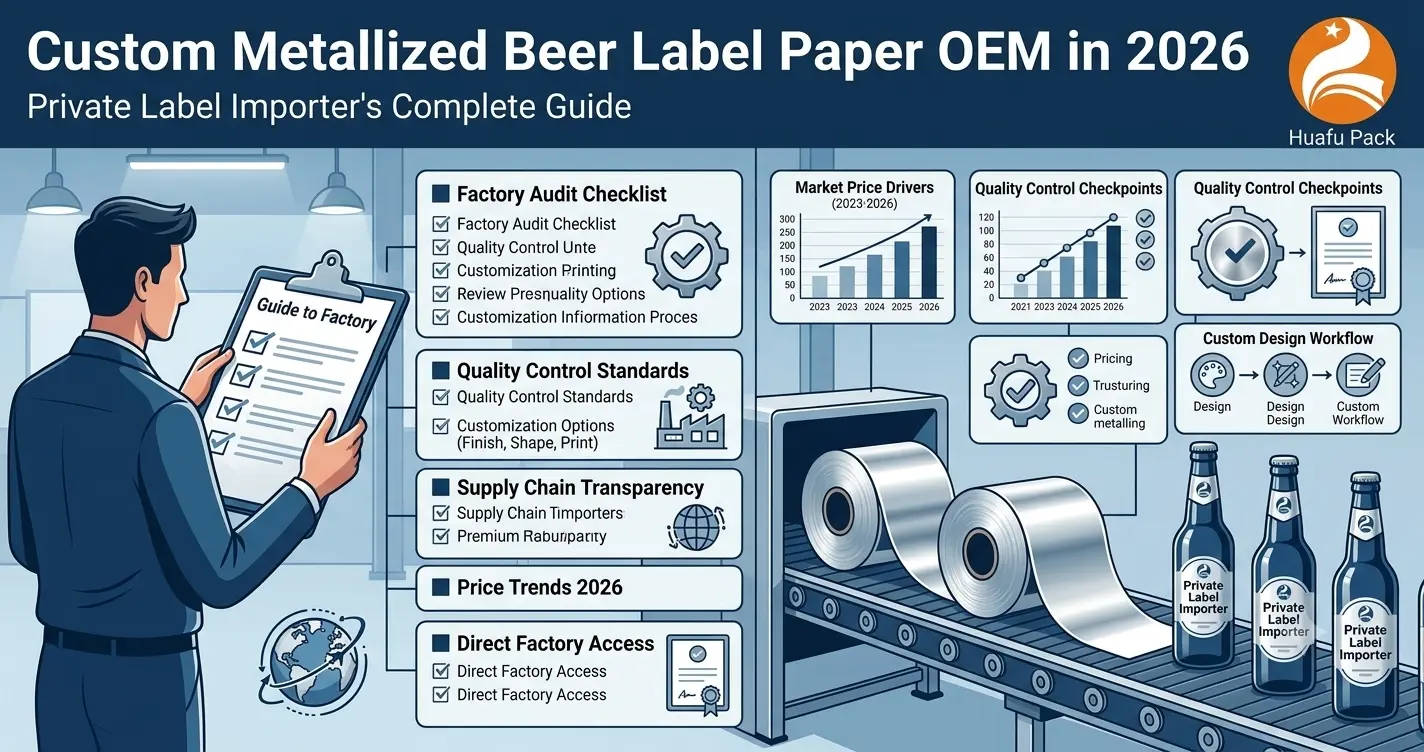
The conversation goes the same way every time. A packaging material distributor in Poland, or Australia, or Mexico — someone who has been buying metallized paper from a Chinese supplier for two or three years, building a client base of local label converters — decides it is time to put their own brand on the product. They want to stop being a buyer and start being a supplier. They want their company name on the roll packaging, their technical data sheet, their brand relationship with a dozen label printers who currently think the product comes from somewhere anonymous in China.
So they call their current Chinese supplier and ask about OEM service. And the answer is some version of: minimum 20 tons per product variant, six-month lead time for a pilot run, separate tooling fees for custom packaging, and by the way — we'd rather not do it at all because OEM orders complicate our production scheduling.
They hang up. They search for alternatives. They find dozens of Alibaba listings claiming "OEM accepted, no minimum quantity" — and discover, when they actually try to place a trial order, that the OEM service is a label stuck to a standard roll with a different company name printed on it and nothing else changed. No custom specifications. No technical documentation in their brand name. No watermark on the product itself. Just a relabeled commodity.
Neither outcome — the factory that won't do it, or the factory that does it in name only — serves a private label importer who is trying to build a serious regional distribution business. What that importer needs is a manufacturer with genuine OEM infrastructure: the ability to customize the product specification, produce under private label packaging with professional finishing, generate technical documentation in the importer's brand identity, and do all of this at commercially viable MOQ levels with sample turnaround fast enough that the business development cycle doesn't stall.
This is that guide. It covers exactly what genuine custom metallized beer label paper OEM looks like at the production level, what can and cannot be customized, how to structure an OEM relationship with a Chinese manufacturer that protects your brand and your margins, and what Huafu Pack's complete OEM/ODM service capability actually delivers — in specific, verifiable terms.
📑 Private Label Importer's OEM Guide — Contents
OEM vs. ODM: Which Model Actually Fits Your Private Label Business?
The Complete OEM Customization Menu: What Can Be Changed, What Cannot
Protecting Your Brand in an OEM Relationship: Documentation, Watermarks & NDA
The 15-Day Sample Protocol: How Fast Development Actually Works
MOQ Economics for Private Label: Why 2 Tons Is the Right Starting Point
Building a Regional Distribution Business on OEM Metallized Paper
FAQ: OEM/ODM Questions, Answered for Private Label Importers
1. OEM vs. ODM: Which Model Actually Fits Your Private Label Business?
The terms OEM and ODM are used interchangeably in most Chinese export marketing — which creates real confusion when a private label importer is trying to specify exactly what service they need. They are not the same thing, and the distinction matters for your supply agreement, your pricing negotiation, and your product development timeline.
OEM — Original Equipment Manufacturer
In the context of metallized paper, OEM means: you specify the product, the manufacturer produces it to your specification. You define the base paper grammage, the optical density target, the surface treatment, the roll width, the core diameter, the roll diameter, and the packaging format. The manufacturer executes your specification using their production equipment and process expertise. The finished product carries your brand name, your technical documentation, and your product code — but the product design originated with you (or with input from both parties during a specification development process).
OEM is the right model for a private label importer who already has a clear product specification — perhaps developed through testing a competitor's product, or through direct feedback from your label converter clients about what they need — and wants a Chinese manufacturer to produce it consistently at scale under your brand.
ODM — Original Design Manufacturer
ODM means: the manufacturer designs the product, you private-label it. Instead of bringing your own specification, you choose from the manufacturer's existing, proven product range — their standard silver metallized paper, their wet-strength grade, their holographic variants — and apply your brand identity to those products. You are not designing the product; you are selecting from a designed product catalog and distributing it under your own name.
ODM is the right model for a first-time private label importer who does not yet have the technical knowledge to write a detailed substrate specification, or who wants to begin their private label business quickly using proven, already-qualified product formulations before investing in custom specification development.
Which Model Is Right for Your Stage of Business?
Most successful private label packaging distributors begin with ODM — choosing from the manufacturer's proven product range, branding it, and selling it into their local market to build a customer base and cash flow. Once they understand their clients' needs well enough to identify specification gaps — a specific grammage their clients want that isn't in the standard range, a core diameter that doesn't fit their clients' press unwinds, a custom color that differentiates their product from competitors — they transition to OEM for those differentiated products while maintaining ODM for the standard range.
2. The Complete OEM Customization Menu: What Can Be Changed, What Cannot
One of the most frequent misunderstandings between private label importers and Chinese manufacturers is the boundary between what is genuinely customizable and what is a fixed manufacturing constraint. A manufacturer who says "everything is customizable" is not being fully honest. A manufacturer who says "we only produce standard specifications" is not the OEM partner you need. Here is an honest, specific account of what can and cannot be customized in a metallized beer label paper OEM program.
✅ What Can Be Fully Customized
Base Paper Grammage (GSM): We produce at any grammage between 50 gsm and 140 gsm in increments of 5 gsm, subject to a minimum production run that justifies the base paper procurement for that specific weight. Standard commercial production grammages (60, 70, 80, 90, 100 gsm) carry the lowest MOQ because base paper is sourced as a stock item. Non-standard grammages (73 gsm, 88 gsm) require a slightly larger minimum run to justify the base paper special order — typically 4–5 tons rather than the standard 2-ton minimum.
Slit Width (Roll Width): Any width between 200mm and 1,300mm is achievable. Custom widths are slit from our standard production web widths (1,000mm, 1,100mm, 1,300mm), which means the slitting combination determines the edge trim waste — and therefore the cost efficiency of your custom width. Widths that divide cleanly into our standard web widths with minimal edge trim (e.g., 500mm from 1,000mm web, or 650mm from 1,300mm web) carry lower conversion cost than widths that create large edge trim losses.
Core Diameter (Inner Diameter): We produce on 76mm (3-inch), 152mm (6-inch), and 300mm cores as standard. Other core diameters (100mm, 127mm) are available with a small tooling setup cost. Core diameter selection should be driven by your clients' press unwind mandrel specification — specify the mandrel diameter, not the core diameter, and we will confirm the appropriate core.
Maximum Roll Diameter (Outer Diameter): Roll outer diameter affects the amount of material per roll and therefore the frequency of roll changeovers on your clients' presses. Standard outer diameters range from 400mm to 800mm. We can produce to a specified maximum outer diameter to match your clients' press specifications.
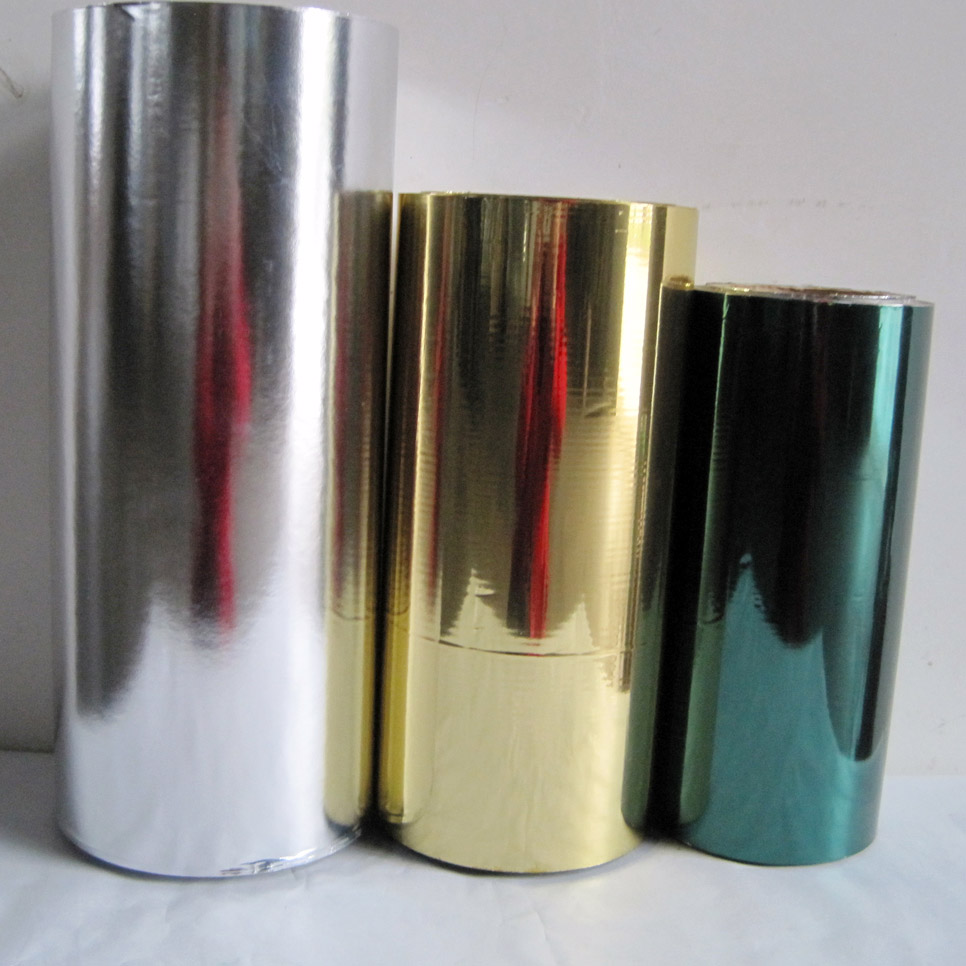
Product Surface Effect: Silver, gold tinting, any of our standard holographic patterns (rainbow linear, starburst radial, fine grain), or a custom holographic pattern with master shim development (additional lead time and tooling investment required for custom patterns). Color metallized variants in the full range of our coating color palette are available for OEM orders.
Wet-Strength and Coating Grade: Standard cold-water grade, standard pasteurization grade (Cobb60 ≤20 g/m²), or high-PU pasteurization grade (Cobb60 ≤15 g/m²). The grade selection should be driven by the most demanding application requirement in your client base — specify the grade you sell, and we will produce and document it consistently to that specification.
Roll Packaging and Labeling: Fully customizable. Your brand name, logo, product name, product code, technical specifications, and contact information can be printed on the roll core label, the end-cap, and the outer packaging wrapping. Your company's branding replaces all Huafu Pack branding on the finished roll presentation. We treat this as a standard OEM service — not a premium add-on.
Technical Documentation in Your Brand Identity: Product data sheet, Certificate of Analysis template, and test method reference document can all be formatted to your company's document template with your brand identity, your product codes, and your contact information. The technical data is Huafu Pack's verified data — the document presentation is yours.
⚠️ What Requires Minimum Volume or Lead Time to Customize
Non-Standard Base Paper Grammage: As noted above — any grammage is achievable, but non-standard grammages require a slightly higher minimum run. Lead time extends by 5–7 days for base paper procurement on non-standard specifications.
Custom Holographic Pattern (Unique to Your Brand): A completely unique holographic diffraction pattern — not one of our standard pattern library options — requires master shim development. This involves a one-time shim tooling investment (quoted case-by-case depending on pattern complexity) and typically adds 4–6 weeks to the initial sample development timeline. The shim tooling is your intellectual property — it is dedicated to your product and not used for any other customer.
Custom Color Metallized Variants Outside Standard Palette: Specific Pantone-matched color metallized variants outside our standard coating color palette require a coating formulation development run. This typically adds 7–10 days to sample development time and may involve a small color development fee for very specific color targets.
❌ What Cannot Be Customized
Core Material (Cardboard): All rolls are wound on cardboard cores. Steel or plastic core alternatives are not available in our production system. If your clients require a specific core wall thickness, specify it and we will confirm whether it falls within our standard core range.
Aluminum Deposition Chemistry: The aluminum used in our vacuum metallization process is high-purity aluminum wire. We do not substitute other metals or alloys in the vacuum deposition process. Specific alloy metallization is not available.
Food-Contact Direct Application: Metallized paper produced at our facility is a label substrate material — it is not manufactured to food-contact direct standards. It is suitable for label applications on food and beverage packaging, not as a direct food-contact layer inside packaging.
| Customization Parameter | Availability | Min. Order Impact | Lead Time vs. Standard |
|---|---|---|---|
| Base Paper GSM (Standard range: 60–100) | ✅ Full | 2 MT | Same as standard |
| Base Paper GSM (Non-standard: e.g., 73, 88 gsm) | ⚠️ Available | 4–5 MT | +5–7 days (paper procurement) |
| Custom Slit Width (200–1,300mm) | ✅ Full | 2 MT | Same as standard |
| Core Diameter (76mm, 152mm, 300mm) | ✅ Full (standard cores) | 2 MT | Same as standard |
| Custom Core Diameter (non-standard) | ⚠️ Available | 2 MT + tooling fee | +3–5 days |
| Surface Effect (Silver / Gold / Standard Holographic) | ✅ Full | 2 MT per variant | Same as standard |
| Custom Holographic Pattern (Unique shim) | ⚠️ Available | 5 MT + shim tooling fee | +4–6 weeks (shim development) |
| Private Label Roll Packaging & Branding | ✅ Full — standard OEM service | No MOQ adder | +2–3 days (packaging print) |
| Technical Documentation in Client Brand Identity | ✅ Full — standard OEM service | No MOQ adder | Same as standard |
| Product Watermark / Logo in Aluminum Layer | ⚠️ Available (selected variants) | 5 MT + watermark tooling | +2–3 weeks (tooling setup) |
3. Protecting Your Brand in an OEM Relationship: Documentation, Watermarks & NDA
A private label importer's greatest commercial asset is the brand equity they build with their local label converter clients. That brand equity depends on two things: product quality consistency, and the assurance that their supplier is not simultaneously selling the same specification directly to their competitors in the same market.
Both concerns are legitimate. Here is how a properly structured OEM relationship addresses each.
Non-Disclosure and Non-Compete Agreement (NDA/NCA)
Before any OEM product specification discussion begins, a bilateral NDA should be signed that covers: confidentiality of the importer's product specification, confidentiality of their pricing, and — for importers building exclusive market positions — a market exclusivity clause that restricts the manufacturer from selling the identical OEM product specification (not the standard catalog product) to buyers in the same geographic market during the contract term.
Huafu Pack signs standard NDA/NCA agreements with OEM clients as a routine precondition of the OEM specification process. We do not treat this as unusual or as a signal of distrust — it is professional commercial practice that protects both parties. Our standard NDA template is available in English. If your legal team requires a specific jurisdiction clause or an adapted format, we work with that.
Product Watermark — The Strongest Brand Protection Tool
For private label importers who want to prevent product substitution — ensuring that the rolls reaching their clients are genuinely their branded product and not a competing supplier's roll that has been repackaged — a product watermark embedded in the aluminum layer itself is the most robust technical brand protection available.
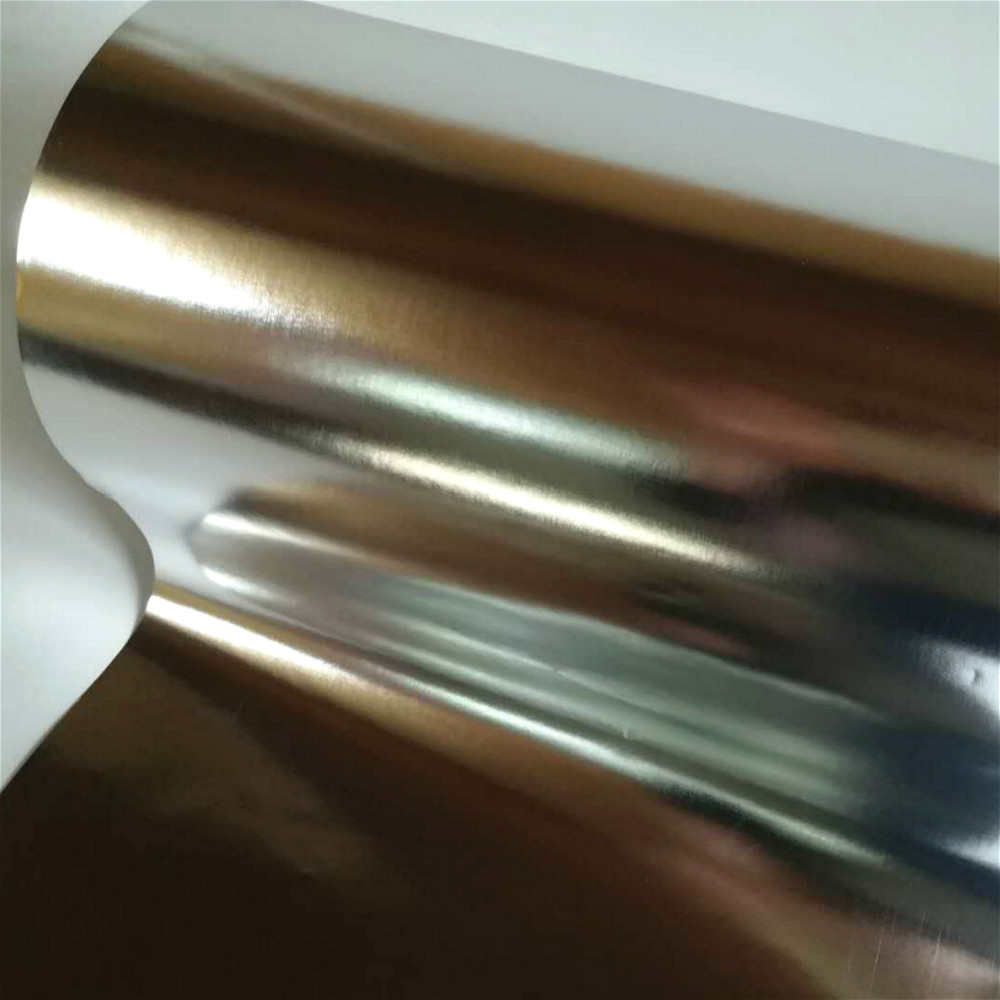
The watermark is applied during the vacuum metallization process using a mask or patterned roller that creates a subtle, repeating logo or text pattern within the aluminum layer. The pattern is visible when the roll is held at a specific angle to a light source — not visible in normal flat viewing — making it a covert authentication feature rather than a visible design element. From the end user's perspective, the label substrate looks identical to a standard metallized paper. For the importer who knows where and how to look, the watermark confirms the product's authenticity and origin.
Watermark tooling requires a one-time setup investment, a minimum production run (typically 5 metric tons to justify the tooling cost amortization), and a 2–3 week tooling fabrication lead time before the first production run. Once the tooling is created, it is exclusive to your brand — no other client receives the same watermark.
Technical Documentation in Your Brand Identity
Every COA, product data sheet, and test report that accompanies a Huafu Pack OEM order can be formatted in your brand identity — your company name, logo, address, product codes, and contact information — with no Huafu Pack branding visible on the document. This is not a nominal label change. We format the documents to your template so that your clients receive what appears to be documentation issued by your company, with the technical data verified by Huafu Pack's quality control system but presented under your brand authority.
📖 Understanding what to specify technically before you write your OEM product brief: Metallized Paper vs. Foil Label vs. BOPP: The Complete Beer Label Substrate Comparison Guide for 2026
4. The 15-Day Sample Protocol: How Fast Development Actually Works
Fifteen days from specification agreement to OEM sample delivery. That is Huafu Pack's standard commitment for OEM sample development on specifications that fall within our standard production capability range. It is not a marketing claim — it is an operational schedule with specific milestones that we can walk through with any prospective OEM client before they commit to a trial order.
Here is what happens inside those 15 days, in sequence.
Days 1–2: Specification Alignment
Once a prospective OEM client submits their specification brief — or works with our export team to develop one — we conduct an internal technical review. Our production planning team confirms that the specified GSM is in stock (or initiates a base paper procurement request for non-standard grammages), confirms the slit width against our slitting machine configuration, and confirms the surface effect against our current production schedule. If any specification element requires a production constraint discussion, we raise it within 48 hours — not after we have already started production. This upfront alignment prevents the most common cause of OEM sample delays: discovering mid-production that a specification element requires a process adjustment that wasn't anticipated.
Days 3–7: Production Run
OEM sample production runs are scheduled as dedicated production slots — not inserted into a standard production run as a secondary priority. The metallization run, coating application, and initial quality verification (OD value, Cobb value, surface tension measurement) happen within this window. For standard specification variants using stock base paper, this stage takes 3–4 days. For variants requiring specialty paper procurement or non-standard coating formulation, this stage may extend by 2–3 days — which is why the specification alignment phase matters.
Days 8–10: Slitting, Finishing & Private Label Packaging
The metallized parent roll is slit to the OEM client's specified width and wound to the specified outer diameter on the specified core diameter. Roll end-caps, core labels, and outer wrap packaging carrying the client's brand identity are applied. The packaging print files — your logo, product name, specification table, contact information — must be provided in PDF or AI format by Day 3 at the latest to avoid delaying this stage. If packaging artwork is not available, we apply a plain branded core label as an interim measure and provide the branded packaging on the first commercial order.
Days 11–13: Quality Verification & Documentation
Full QC inspection of the finished sample roll: OD value at five cross-web positions, Cobb60 measurement, surface tension at three positions, wet tensile strength (for pasteurization-grade variants), caliper verification. COA generated in the client's brand identity document template. Photographs taken for shipping documentation. Sample packing list prepared.
Days 14–15: Dispatch & DHL Tracking
OEM samples are shipped via DHL Express (or equivalent international courier) by Day 15. DHL tracking number provided to the client on the day of dispatch. Estimated transit time to European destinations: 3–5 business days. To North American destinations: 4–6 business days. To Southeast Asia: 2–4 business days.
5. MOQ Economics for Private Label: Why 2 Tons Is the Right Starting Point
The 2-metric-ton minimum order quantity for standard OEM specifications is not an arbitrary threshold. It reflects the economic reality of setting up and running a dedicated production and slitting run in a way that delivers consistent quality while keeping the per-ton unit cost in a commercially viable range for both manufacturer and distributor. Understanding the economics behind it helps private label importers negotiate confidently and plan their inventory cycles realistically.
The Slitting Run Economics
When a parent roll of metallized paper — typically 1,000mm or 1,300mm wide and several hundred kilograms — is slit to a custom width, the slitting machine must be set up specifically for that width configuration. Machine setup time is a fixed cost that does not change with run length. A 500 kg slitting run carries the same setup cost as a 2,000 kg slitting run — but spreads that cost across four times fewer kilograms. The result: below 2 tons, the per-ton cost of a custom width slit increases sharply, and the factory cannot offer a commercially competitive price without either absorbing the loss or degrading the product quality to compensate.
The Inventory and Cash Flow Case for 2 Tons
For a regional packaging distributor, a 2-ton order of standard silver 80 gsm metallized beer label paper in a 1,000mm width translates to approximately:
Approximately 25,000 square meters of material (at 80 gsm and typical roll geometry)
Sufficient material for approximately 10 million to 15 million standard beer front labels (90mm x 130mm label size)
Enough stock to supply a regional distributor's label converter clients for 2–4 months depending on local market demand
A 2-ton trial order is therefore not a nominal sample — it is a commercially meaningful inventory position that allows a private label distributor to supply real orders from real clients, generate real revenue, and evaluate the product's market acceptance before committing to a larger annual volume agreement.
Scaling to Annual Volume: The Price-Volume Curve
| Annual Volume Commitment | Typical Price Reduction vs. Trial Order | Recommended Shipment Schedule | Private Label Service Level |
|---|---|---|---|
| 2 MT (Trial order) | Baseline (trial pricing) | Single shipment | Full OEM packaging + COA in brand identity |
| 6–10 MT / year | 3–5% below trial price | Quarterly (2–3 MT per shipment) | Full OEM + priority scheduling + NDA + geographic discussion |
| 15–30 MT / year | 6–10% below trial price | Bi-monthly (3–5 MT per shipment) | Full OEM + watermark option + market exclusivity negotiable + dedicated account manager |
| 50+ MT / year | 12–18% below trial price | Monthly (4–6 MT per shipment) | Full OEM + custom holographic shim + full market exclusivity + annual strategic review |
📖 For pricing context and how to evaluate whether your OEM unit cost is competitive: Metallized Beer Label Paper Price in 2026: A Factory's Transparent Guide to Fair Market Cost & FOB Pricing
6. Building a Regional Distribution Business on OEM Metallized Paper
A private label metallized paper program is not a product purchase. It is a business architecture decision. The importers who build sustainable, profitable regional distribution businesses on OEM metallized paper share three operational habits that distinguish them from importers who buy a few branded rolls, fail to gain market traction, and conclude that private label doesn't work in their market.
Habit 1: They Build the Technical Story Before They Build the Sales Deck
Label converters — the primary buyers of metallized beer label paper — are not purchasing managers who respond to brochures. They are production professionals who need to know whether a substrate will run on their press without modification, what ink systems are compatible, what surface tension the material delivers, and whether the COA format matches their incoming inspection protocol. The private label importers who win converter accounts are those who show up with a complete technical package — product data sheet, COA template, press trial sample, and a clear answer to the question "what surface tension does this deliver and how is it verified per batch?" — not just a branded roll and a price.
The technical content for that package already exists in Huafu Pack's product documentation. As an OEM client, you receive that documentation formatted in your brand identity. Your job is to understand it well enough to present it confidently to a technical audience — not to generate it from scratch.
Habit 2: They Start with One Product Done Well, Not Five Products Done Superficially
The most common private label program failure pattern is an importer who launches five product variants simultaneously, holds minimal stock of each, and cannot respond quickly when a client needs a repeat order. Their clients try the product, like it, ask for a reorder — and wait four weeks for a container from China while a local supplier delivers in three days.
The successful pattern is: one product, deeply stocked, with the ability to supply from local inventory within 48 hours. For a beer label paper distributor, that one product is almost always standard silver metallized paper in the 80 gsm specification, slit to the most common press web widths in your market. Get that single product right — reliable stock, fast delivery, consistent quality, credible technical support — and the additional product variants sell themselves when converter clients ask what else you carry.
Habit 3: They Treat Their Chinese Manufacturer as a Technical Resource, Not Just a Supplier
The OEM importers who build the strongest regional market positions are those who actively leverage their manufacturer's technical knowledge as a competitive advantage in their local market. When a converter client reports a press adhesion problem with a competing substrate, the successful private label distributor can call Huafu Pack's technical team, describe the symptom, and return to the client with a specific diagnosis and a substrate recommendation — within 24 hours. This level of technical support depth is not available from a local paper merchant who carries the product but doesn't manufacture it. It is the structural competitive advantage of a private label relationship with a direct manufacturer over a trading company supply relationship.
7. FAQ: OEM/ODM Questions, Answered for Private Label Importers
A: Yes — and this is actually the most common starting point for new OEM clients. Send us the following information: the type of beer labels your clients produce (cold channel only, pasteurized product, returnable bottle program, or a mix), the label printer's press type (UV flexo, offset, or gravure), the approximate label size range (this helps us recommend the right roll width options), and the approximate annual volume you expect to distribute in your first year. From that brief, we will recommend a starting specification and provide A4 samples of each recommended product variant for initial evaluation — before any order commitment. The specification brief template we send you for completion takes approximately 20 minutes to fill in and gives us everything we need to make a precise product and pricing recommendation.
A: This is the right question to ask, and it deserves a specific answer rather than a general reassurance. For OEM clients operating under a signed market exclusivity clause for their specific product specification and geographic territory, we do not supply that specification to direct buyers in the covered territory during the contract term. For standard catalog products without an exclusivity clause, we may sell to any buyer globally — because the standard catalog product is not your proprietary specification, it is our commercial product range. This is why the distinction between OEM (your specification) and ODM (our catalog product) matters for market protection: OEM specifications can be protected by exclusivity; ODM product selections cannot be exclusively locked without an additional commercial agreement. We recommend that serious private label distributors always begin with at least one genuinely OEM custom specification — even if it differs from our standard range only in one parameter — so that the exclusivity protection is technically anchored to a specification that is specific to your program.
A: Yes — your packaging design is used, not ours. The standard information that should appear on professional OEM metallized paper roll packaging includes: your company name and logo, your product name and code, the substrate specification (GSM, roll width, core diameter, surface effect), the batch number and production date, the net weight and gross weight, your contact information (phone, email, website), and any hazard or storage instruction symbols required for import into your destination country. We recommend including a QR code linking to your online product data sheet — this gives your converter clients instant access to the technical documentation without requiring a physical data sheet to be included in every shipment. If you provide us with a print-ready PDF or AI file in your brand identity, we print the packaging labels and apply them before shipping. No Huafu Pack branding appears on the finished OEM roll presentation.
A: The cleanest transition process follows four steps. First, send us a roll of your current product — or a detailed COA from your current supplier — so we can analyze the existing specification and confirm whether we can match or improve it. Second, we produce an OEM sample to your matched specification and send it for comparative testing alongside your current product. Third, if the comparative press trial confirms equivalent or superior performance, we run a 2-ton trial order in your full OEM packaging to validate commercial production consistency. Fourth, once the trial order is approved, we set up a recurring production and shipment schedule that allows you to transition volume from your current supplier to Huafu Pack progressively — typically over two to three shipment cycles — without disrupting your clients' supply. You do not need to switch suppliers in a single cut-over event. The staged transition approach manages the risk for your clients and for your business simultaneously.
Your Brand. Our Factory. Samples in 15 Days.
Tell Susan, Vivian, or Janet what you need: your target market, your client base (label converters or breweries), your approximate annual volume, and whether you have an existing specification or need help developing one. We will send you a specification brief template, A4 product samples, and an OEM quotation — all within two business days. No commitment required to start the conversation.
📍 Xianning High-Tech Zone, Hubei Province, China | ✉️ sales@huafupacking.net | 📞 +86-13797805927
Mr. Xiao manages OEM and private label business development at Huafu Packing Material Co.,Ltd, Xianning. Over the past decade he has structured OEM programs for regional packaging distributors across Europe, Southeast Asia, the Americas, and the Middle East — from a single-product 2-ton trial to multi-variant annual programs exceeding 100 metric tons. He writes for importers who want to build a real distribution business, not just put their name on a roll of paper.
References & Standards
ISO 535:2014 — Cobb value test standard referenced in OEM product specification and per-batch COA documentation requirements.
ISO 8296:2003 — Surface tension measurement standard referenced in OEM product data sheet and incoming inspection protocol for private label distributors.
FINAT Technical Handbook (9th Edition) — Section 9: Special effect and metallized label substrate standards applicable to OEM product specification and converter qualification documentation.
China Customs HS Classification — HS Code 4811.51 (Metallized Paper, coated) and 4811.59 (Other coated paper): applicable export classification for OEM shipments with private label packaging. Importers should verify import duty classification in their destination country using the equivalent HS code.
Huafu Packing Material Co.,Ltd — OEM Client Program Documentation, NDA Template (English version), and 15-Day Sample Protocol Standard Operating Procedure, Xianning Facility, 2015–2026.